.svg)
Einleitung
Die meisten Artikel über Anforderungsmanagement erzählen dieselbe Geschichte.
Ein Systemingenieur leitet einen Stakeholder-Workshop. Er zerlegt einen Marktbedarf in hundert testbare Aussagen. Er erstellt eine Baseline für die Spezifikation und verfolgt diese durch Design und Verifizierung. Diese Welt hat ihre Standards (ISO/IEC/IEEE 29148, das INCOSE Systems Engineering Handbook), ihre Werkzeuge (IBM DOORS, Jama Connect, Polarion, Visure) und dreißig Jahre Literatur im Rücken.
Dieser Artikel handelt von der anderen Geschichte.
Die Geschichte, in der an einem Montagmorgen ein 300-seitiges URS in Ihrem Posteingang landet. In der eine Ausschreibung über ein Beschaffungsportal mit acht Anhängen und einer 12-wöchigen Frist eintrifft. In der ein Plattform-OEM Ihnen ein Qualitätsmanagementhandbuch für Tier-1-Zulieferer schickt, das 4.000 neue Klauseln zu einem Programm hinzufügt, von dem Sie dachten, der Umfang stünde bereits fest.
„Bei Beam Berlin verbrachten die Ingenieurteams die ersten zwei Wochen jedes Projekts nur damit, Ausschreibungsunterlagen zu analysieren, bevor überhaupt mit der eigentlichen Arbeit begonnen werden konnte. Die Anforderungen existierten. Sie waren nur völlig unhandlich.“
— Kareem Bayoun, CEO, Booma
Diese Seite des Anforderungsmanagements wird seit vierzig Jahren in Excel betrieben. Die Ingenieure, die dies tun – Angebotsmanager, Projektleiter, Vertriebsingenieure, Systemintegratoren, EPCs, Tier-1-Zulieferer – sind zahlenmäßig weit überlegen gegenüber der Seite, die Anforderungen erstellt. Und bis vor Kurzem hat niemand Software für sie entwickelt.
Dieser Leitfaden behandelt, was Anforderungsmanagement tatsächlich bedeutet, wenn man beide Seiten berücksichtigt, warum die etablierten Werkzeuge für eine dieser Seiten nicht ausreichen und wie KI die Wirtschaftlichkeit auf der Empfängerseite verändert.
[KEY TAKEAWAYS]
- Wenn Sie Kundenspezifikationen erhalten, anstatt Ihre eigenen zu schreiben, führen Sie eine andere Tätigkeit aus, als in den meisten Inhalten zum Anforderungsmanagement beschrieben wird. Die Werkzeuge, die für diese andere Aufgabe entwickelt wurden (DOORS, Jama, Polarion, Visure), passen hier nicht nahtlos.
- Der Workflow auf der Empfängerseite umfasst neun Schritte: Empfangen, Extrahieren, Atomisieren, Klassifizieren, Zuweisen, Abgleichen, Antworten, Nachverfolgen, Einreichen.
- Übersehene Klauseln, fragmentierte Konformitätsnachweise und der Verlust der Rückverfolgbarkeit sind die Fehlerquellen, die Teams auf der Empfängerseite am teuersten zu stehen kommen. Sie treten selten sofort auf. Sie zeigen sich erst bei der Werksabnahme (FAT), achtzehn Monate nach Zuschlagserteilung.
- KI-gestützte Plattformen wie Booma automatisieren die Schritte, die auf der Empfängerseite wertvolle Zeit der Ingenieure beanspruchen – von der Extraktion über Konformitätsvorschläge bis hin zum Versionsvergleich.
Was ist Anforderungsmanagement?
Anforderungsmanagement ist die Praxis des Erfassens, Organisierens, Klassifizierens, Nachverfolgens und Beantwortens von Anforderungen im Rahmen eines Projekts oder einer vertraglichen Beziehung.
Was das im Tagesgeschäft bedeutet, hängt vollständig davon ab, auf welcher Seite des V-Modells Sie sich befinden.
Wenn Sie die Anforderungen schreiben und verantworten, sieht Ihre Arbeit so aus: Stakeholder-Workshops leiten, das, was das System leisten muss, in testbare Aussagen zerlegen, den genehmigten Satz als Baseline festlegen, das Gebaute gegen das Geschriebene verifizieren. Das ist die Welt des OEM, des Systeminhabers, der Produktorganisation.
Wenn Sie auf der anderen Seite stehen und ein Kundendokument erhalten, anstatt selbst eines zu schreiben, ist die Aufgabe eine andere. Ein Dokument trifft ein. Sie ziehen jede Klausel heraus, teilen zusammengesetzte Aussagen in atomare Anforderungen auf, klassifizieren jede einzelne, gleichen sie mit Ihren Produktfähigkeiten ab, leiten sie an das richtige interne Team weiter, entwerfen eine Konformitätsantwort und reichen eine strukturierte Matrix an den Kunden zurück. Diese Matrix muss achtzehn Monate später bei der Werksabnahme standhalten.
Beide Seiten nutzen das gleiche Vokabular. Beide benötigen Rückverfolgbarkeit und Änderungskontrolle. Doch die Ergebnisse unterscheiden sich, die Fehlerquellen sind andere, und sie als identische Aufgabe zu behandeln, kostet Teams bares Geld.
Das meiste, was über Anforderungsmanagement, Standards, Werkzeugvergleiche und Anleitungen geschrieben wird, richtet sich an die Erstellerseite. Dieser Artikel ist für die andere Seite: das Team, das das Dokument erhält und es interpretieren muss.
Die zwei Seiten des V-Modells
Das V-Modell bildet den technischen Lebenszyklus ab. Linke Seite: Konzept, Anforderungen, Design, Implementierung. Rechte Seite: Komponententests, Integration, Systemvalidierung.
Für ein einzelnes Unternehmen, das sein eigenes Produkt von Anfang bis Ende entwickelt, liegen beide Seiten innerhalb derselben technischen Abteilung. DOORS oder Jama steuern dabei den gesamten Kreislauf.
Doch der Großteil der Ingenieursarbeit findet in Lieferketten statt. Der OEM schreibt das URS auf seiner eigenen linken Seite des V-Modells. Der Tier-1-Zulieferer erhält dieses URS und führt als Reaktion darauf ein eigenes, vollständiges V-Modell durch, das genau dort beginnt, wo das Dokument des Kunden endet.
Wer erledigt diese Arbeit eigentlich?
Das Anforderungsmanagement auf der Empfängerseite gehört zum Tagesgeschäft bestimmter Rollen. Sie werden nicht immer als Angebotsingenieure oder Proposal Manager bezeichnet, aber die Aufgabe ist klar erkennbar.
- Angebotsingenieure und Proposal Manager in der Industrieausrüstung, bei EPC-Unternehmen und Systemintegratoren erhalten zu Beginn jeder Gelegenheit eine Ausschreibung, ein URS oder eine Anfrage und müssen diese bis zur Frist in ein strukturiertes Angebotsdokument umwandeln. Manche von ihnen bearbeiten fünfzig Ausschreibungen pro Jahr.
- Vertriebsingenieure und Applikationsingenieure bei Herstellern von Investitionsgütern erhalten Kundenspezifikationen und müssen prüfen, ob das Standardprodukt des Unternehmens die einzelnen Klauseln erfüllen kann – und falls nicht, wie die kundenspezifische Anpassung aussehen muss.
- Systemintegratoren in den Bereichen Luft- und Raumfahrt, Verteidigung, Intralogistik, Transport und Energie erhalten mehrbändige Spezifikationen von Hauptauftragnehmern oder Endkunden und zerlegen diese in Arbeitspakete und Lieferantenanforderungen.
- Tier-1-Automobilzulieferer arbeiten mit OEM-Qualitätshandbüchern, IATF-gesteuerten Spezifikationen, PPAP- und APQP-Meilensteinanforderungen sowie plattformspezifischen Anhängen zur funktionalen Sicherheit – oft von mehreren OEMs gleichzeitig.
- Technische Einkaufsteams in regulierten Branchen erhalten URS-Dokumente und leiten diese an Ausrüstungslieferanten weiter. Sie agieren auf beiden Seiten der Schnittstelle.
- Fertigungsteams für kundenspezifische Anlagen behandeln jeden Kundenauftrag als eine individuelle Konfigurationsantwort auf eine Kundenspezifikation.
Die Dokumente, die sie erhalten, sehen branchenunabhängig ähnlich aus: 100- bis 500-seitige PDFs in verschiedenen Sprachen, eingebettete Tabellen, referenzierte Anhänge, regulatorische Querverweise, in Fließtext eingebettete kommerzielle Bedingungen und mehrere Versionierungsebenen, die erst durch einen direkten Vergleich der Revisionen sichtbar werden.
Die Aufgabe besteht darin, dieses Dokument vor Ablauf einer vertraglichen Frist in eine strukturierte, prüfbare Compliance-Antwort umzuwandeln, ohne dabei eine Klausel zu übersehen, die zu einer fünfstelligen Vertragsstrafe führen könnte, sobald die Ausrüstung bereits vor Ort ist.
Warum die Empfängerseite auf der Strecke geblieben ist
Software für das Anforderungsmanagement gibt es als Kategorie seit den 1990er Jahren. IBM DOORS wurde ursprünglich für große Verteidigungs- und Luftfahrtunternehmen entwickelt, die Anforderungen für umfangreiche, langjährige und regulierte Programme verfassten. Jama, Polarion und Visure folgten mit der gleichen Positionierung und der gleichen Zielgruppe: dem Systemingenieur, der die Anforderungen seines eigenen Unternehmens durch V-Modell-Prozesse verwaltet.
Jedes dieser Tools wurde für das Team entwickelt, das die Spezifikationen schreibt. Wenn Ihre Aufgabe darin besteht, die 400-seitige URS eines anderen zu verstehen, erhalten Sie bestenfalls eine „Import aus PDF“-Schaltfläche, die ohnehin niemand wirklich nutzt.
Das Ergebnis: Angebots-Engineering-Teams bei Anlagenbauern mit hunderten Millionen Euro Umsatz verwalten 200-Klausel-Angebotsanfragen immer noch in farbcodierten Tabellenkalkulationen, kopieren Compliance-Antworten zwischen verschiedenen Projekten hin und her und erstellen die Compliance-Matrix jedes Mal von Grund auf neu, wenn ein Kunde eine Revision herausgibt.
Niemand hatte den Plan, Millionen-Euro-Angebote in einer Tabellenkalkulation zu verwalten; es wurde einfach nie dringlich genug, dies zu ändern – bis die Angebote größer, die Dokumente länger und die Folgen übersehener Details kritisch wurden.
Wie Anforderungsmanagement auf der Empfängerseite funktioniert
Die meisten Teams, die diese Arbeit heute leisten, führen einige Versionen dieser neun Schritte manuell aus.
Schritt 1: Empfang
Ein vom Kunden ausgestelltes Dokument geht ein: URS, Angebotsanfrage (RFQ), Ausschreibung (ITT), technisches Lastenheft oder Vertragszusatz. Meist als PDF oder Word-Datei, manchmal mit Excel-Anhängen, Zeichnungssätzen oder referenzierten Normen. Die erste Aufgabe besteht darin, es in einem System zu erfassen, in dem Kundenname, Projekt, Dokumentenversion und Abgabefrist von Anfang an hinterlegt sind.
Schritt 2: Extraktion
Jede Anforderungsklausel wird aus dem Dokument extrahiert. Eine 300-seitige URS verbirgt typischerweise 400 bis 1.500 einzelne Anforderungen in Fließtexten, Tabellen, Fußnoten und Bildunterschriften. Die manuelle Extraktion dauert Tage. KI-gestützte Extraktion benötigt Minuten und erkennt Anforderungen, die menschliche Prüfer etwa ab Seite 180 übersehen.
Schritt 3: Atomisierung
Zusammengesetzte Anforderungen werden in atomare Aussagen zerlegt. „Das Förderband muss mit 1,2 m/s betrieben werden und gemäß Maschinenrichtlinie 2006/42/EG CE-gekennzeichnet sein“ sind zwei Anforderungen, nicht eine, da man die Geschwindigkeit einhalten, aber die Kennzeichnung vergessen kann – oder umgekehrt. Überspringt man diesen Schritt, werden sowohl die Compliance als auch die Nachweisbarkeit bei Audits auf der falschen Detailebene bewertet.
Schritt 4: Klassifizierung
Jede atomare Anforderung wird nach Typ (funktional, Leistung, Schnittstelle, Sicherheit, regulatorisch, kommerziell, umweltbezogen, Dokumentation), Kritikalität und Fundstelle (genaue Seite und Absatz im Kundendokument) getaggt. Die Klassifizierung steuert alle nachgelagerten Prozesse, einschließlich der Zuweisung an das zuständige Team und der Darstellung in der Compliance-Matrix.
Schritt 5: Interne Verantwortlichkeiten zuweisen
Anforderungen werden an die richtigen internen Teams weitergeleitet. Eine URS für eine Batterielinie mit 600 Klauseln kann sich auf Angebots-Engineering, Prozess-Engineering, Steuerungstechnik, End-of-Line-Prüfung, Qualitätssicherung, funktionale Sicherheit und Cybersicherheit verteilen. Jedes Team ist für seinen Bereich verantwortlich. Das Angebots-Engineering behält den konsolidierten Überblick.
Schritt 6: Abgleich mit den eigenen Fähigkeiten
Jede Klausel wird mit den Standard-Produktfähigkeiten des Teams, den auftragsbezogenen Optionen oder früheren Angebotsantworten abgeglichen. Hier zahlt sich eine wachsende Wissensdatenbank am meisten aus. Das dritte Angebot für einen Kundenstamm sollte schneller erstellt sein als das zweite. Das zehnte sollte größtenteils automatisch entworfen werden.
Schritt 7: Entwurf der Compliance-Antwort
Für jede Klausel verfasst das Team eine Antwort: Vollständig konform, teilweise konform mit benannter Option und Preisdifferenz, nicht konform mit prinzipieller Ablehnung oder Umfang der technischen Prüfung, oder nicht relevant. Jede Antwort verweist auf interne Belege: einen Abschnitt der Standard-Produktspezifikation, eine frühere Angebotsantwort oder einen Prüfbericht.
Schritt 8: Rückverfolgbarkeit und Versionskontrolle
Jede Klausel wird von ihrer Quellseite und ihrem Absatz über interne Belege bis hin zur Compliance-Antwort nachverfolgt. Wenn der Kunde eine Überarbeitung herausgibt, zeigt die Versionskontrolle, welche Klauseln geändert wurden, welche Compliance-Antworten aktualisiert werden müssen und welche unverändert übernommen werden können. Kundenrevisionen während einer Angebotsphase sind keine Ausnahmefälle. Sie sind der normale Betriebsmodus.
Schritt 9: Einreichen
Eine konsolidierte Compliance-Matrix wird exportiert und eingereicht, wobei die zugrunde liegenden Belege für Audits, FAT, SAT und etwaige Streitigkeiten nach der Abnahme, die Jahre später auftreten, aufbewahrt werden.
Häufige Fehlerquellen
„Das Wissen geht mit ihnen verloren. Das wollen Sie nicht. Sie möchten, dass das gesamte Wissen in einer Umgebung orchestriert wird, damit neue Mitarbeiter genau dort anfangen können, wo der leitende Ingenieur aufgehört hat.“
— Kareem Bayoun, CEO, Booma
Übersehene Klauseln
Eine auf Seite 247 eines URS versteckte Klausel wird bei der manuellen Extraktion übersehen. Das Angebot wird gewonnen. Monate später taucht diese Klausel beim FAT auf, der Lieferant ist vertragsbrüchig und die Nachrüstungskosten bleiben an ihm hängen.
Doppelte Arbeit bei ähnlichen Angeboten
Ein Lieferant beantwortet pro Jahr zehn URS-Dokumente, die auf Klauselebene zu 60 bis 70 Prozent identisch sind. Jede Antwort wird von Grund auf neu erstellt, da es keine wachsende Wissensdatenbank gibt. Dasselbe Compliance-Argument wird von zehn verschiedenen Ingenieuren für zehn verschiedene Angebote geschrieben.
Fragmentierte Compliance-Nachweise
Ein URS mit 450 Klauseln wird auf acht interne Teams aufgeteilt. Die Antworten jedes Teams liegen in eigenen Tabellenkalkulationen. Die konsolidierte Matrix wird manuell zusammengestellt, oft in den letzten 48 Stunden vor der Einreichung. Inkonsistenzen gelangen so in das kundenseitige Dokument.
Verlust der Rückverfolgbarkeit zwischen Angebotsannahme und FAT
Das Angebot wird gewonnen. Achtzehn Monate vergehen. Das FAT-Skript verweist auf spezifische vertragliche Verpflichtungen. Die ursprünglichen Compliance-Nachweise haben sich in den Posteingängen ausgeschiedener Ingenieure, auf nicht gepflegten Netzlaufwerken und in Übergabepräsentationen vom Kick-off-Meeting, die niemand ordnungsgemäß gespeichert hat, verstreut.
Kundenrevisionen, die die Antwort ungültig machen
Der Kunde veröffentlicht die URS Rev 4. Zwölf Klauseln wurden geändert. Ohne automatisierten Versionsvergleich ist das Identifizieren der betroffenen Compliance-Antworten eine manuelle Arbeit Seite für Seite, die eine ohnehin schon knappe Frist um Tage verlängert.
Vorteile einer effizienten Eingangsseite
[TABLE]
Vorteil
- Schnellere Angebotsabgabe
- Höhere Klauselabdeckung
- Wachsende Wissensdatenbank
- Audit-sichere Rückverfolgbarkeit
- Schnellere Anforderungsprüfung
- Kontrollierte Revisionsverwaltung
Was das in der Praxis bedeutet
- EuroSort konnte den Bearbeitungsaufwand pro Projekt nach der Einführung von Booma von 52 auf 8 Stunden senken, was eine geschätzte Ersparnis von 57.000 € pro Jahr bedeutet.
- Die KI-gestützte Extraktion erkennt Anforderungen in langen Dokumenten, die menschlichen Prüfern entgehen würden. CIMC Pteris prüft Spezifikationen nun automatisch gegen mehr als sieben referenzierte Standards, anstatt dies manuell zu tun.
- Compliance-Antworten aus früheren Angeboten werden bei neuen Klauseln automatisch vorgeschlagen. Das zehnte Angebot für einen Kundenstamm ist deutlich schneller erstellt als das erste.
- Jede Klausel ist mit ihrer Quellseite, internen Nachweisen und der Compliance-Antwort verknüpft, was CIMC Pteris eine durchgängige Rückverfolgbarkeit über den gesamten Angebotslebenszyklus ermöglicht.
- CIMC Pteris konnte die Prüfzeit für eingehende Spezifikationen auf unter eine Stunde reduzieren, bei hundertprozentiger Sichtbarkeit der Anforderungen im gesamten Dokument.
- Vom Kunden herausgegebene Revisionen werden automatisch abgeglichen. Betroffene Compliance-Antworten werden sofort markiert.
Praxisbeispiel
CIMC Pteris ist Asiens größter Integrator für Flughafenlogistik. Die Ausschreibungsunterlagen umfassen regelmäßig 500 bis 1.000 Seiten und nehmen gleichzeitig Bezug auf mehr als sieben EN-ISO-Normen.
Vor Booma war die Bearbeitung einer neuen URS ein wochenlanger manueller Prozess, bevor überhaupt mit der eigentlichen Angebotsausarbeitung begonnen werden konnte. Kundenänderungen während der Angebotsphase bedeuteten, dass große Teile dieser Arbeit von vorn begonnen werden mussten.
Nach der Implementierung von Booma konnte CIMC Pteris die Zeit für die Anforderungsprüfung eingehender Spezifikationen auf unter eine Stunde senken und jedes Dokument automatisch mit sieben oder mehr referenzierten Normen abgleichen. Das Team hat nun volle Transparenz über jede Anforderung in einem Dokument, mit durchgängiger Rückverfolgbarkeit von der Quellklausel bis zur Compliance-Antwort.
„Wenn ein Kunde mitten im Projekt eine Änderungsanforderung stellt, haben wir früher Tage damit verbracht, diese in den Dokumenten nachzuverfolgen. Mit Booma können wir noch am selben Tag eine fundierte, prüfungssichere Antwort geben.“
— Gustav Ryan, Operations Director bei CIMC Pteris
Was sich durch KI wirklich verändert hat
Vor fünf Jahren war all dies nicht mit akzeptabler Genauigkeit automatisierbar. Drei Dinge haben sich geändert.
- Die Extraktion wurde zuverlässig. Multimodale Sprachmodelle extrahieren heute atomare Anforderungen aus 300-seitigen PDFs mit einer Genauigkeit von über 99 Prozent bei sauberen Dokumenten. Die Extraktion ist nicht mehr der Engpass, der sie einmal war.
- Compliance-Vorschläge begannen zu funktionieren. Booma trainiert auf Basis der Angebotshistorie eines Unternehmens und schlägt Compliance-Antworten für neue Klauseln vor. Dabei wird neben der früheren Antwort und deren Begründung ein Ähnlichkeitswert (zum Beispiel „80 % ähnlich“) angezeigt. Ingenieure prüfen und entscheiden, anstatt von Grund auf neu zu formulieren.
- Sprachübergreifende Extraktion wurde zum Standard. Zulieferer in Deutschland, Österreich, Italien und ganz Asien erhalten routinemäßig URS-Dokumente von Kunden auf Englisch, Französisch, Mandarin, Koreanisch, Russisch und Arabisch. Booma extrahiert sprachübergreifend, ohne dabei technische Nuancen zu verlieren.
Zusammengenommen haben diese Veränderungen den Workflow auf der Empfängerseite auf eine Weise automatisierbar gemacht, wie es vor fünf Jahren noch nicht möglich war. Teams, die spezialisierte Software einsetzen, arbeiten nicht nur schneller am gleichen Arbeitsaufwand. Sie erkennen Klauseln, die einem müden Prüfer auf Seite 180 entgehen würden, nehmen Angebote an, die sie sonst hätten ablehnen müssen, und nutzen das Wissen aus den letzten zehn Angeboten, anstatt beim elften wieder bei Null anzufangen.
Wie Booma hilft
Booma ist eine Plattform für Anforderungsintelligenz, die für die Empfängerseite des V-Modells entwickelt wurde. Die Kunden sind Angebotsingenieure, Vertriebsingenieure, Systemintegratoren, EPCs und Tier-1-Zulieferer, die auf kundenseitige Spezifikationen reagieren, und keine Systemingenieure, die die Anforderungen für ihre eigenen Produkte verfassen.
Wenn Ihr Team die Anforderungen selbst schreibt und verwaltet, gehören DOORS oder Jama wahrscheinlich bereits zu Ihrem Stack – und das ist auch das richtige Werkzeug für diese Aufgabe. Wenn die Arbeit Ihres Teams jedoch erst beginnt, wenn die Anforderungen eines anderen in Ihrem Posteingang landen, ist das eine andere Aufgabe, für die Booma entwickelt wurde. Viele Unternehmen nutzen beides parallel, da beide Aufgaben innerhalb derselben Lieferkette existieren.
Booma unterstützt technische Teams auf der Empfängerseite, indem es jede Klausel aus kundenseitigen Dokumenten – ob PDF, Word oder Excel – über mehrere Sprachen hinweg extrahiert und Anforderungen aufspürt, die in Fließtexten, Tabellen, Fußnoten und Querverweisen versteckt sind. Wenn eine neue Klausel eingeht, wird sie mit der Angebotshistorie des Unternehmens abgeglichen und frühere Compliance-Antworten werden mit einem Ähnlichkeitswert angezeigt. So kann ein Ingenieur einen Vorschlag prüfen und verfeinern, anstatt jedes Mal von Grund auf neu zu schreiben.
Von dort aus werden die Anforderungen mit automatischen E-Mail-Benachrichtigungen an das jeweils zuständige interne Team weitergeleitet. So wird aus einer URS mit 600 Klauseln nicht ein Dutzend separater Tabellen, die zwei Tage vor Abgabefrist mühsam von Hand zusammengefügt werden müssen. Jede Klausel behält zudem ihre Verbindung zur ursprünglichen Seite und zum Absatz, über die internen Nachweise bis hin zur Compliance-Antwort selbst – eine Kette, die von der Angebotsannahme bis hin zu FAT, SAT und eventuellen späteren Streitfällen Bestand haben muss.
Booma wird in Deutschland gehostet, ist ISO 27001-zertifiziert, DSGVO-konform und nutzt vertraglich zugesichert keine Kundendaten zum Training von KI-Modellen.
[FAQ]
Was ist Anforderungsmanagement?
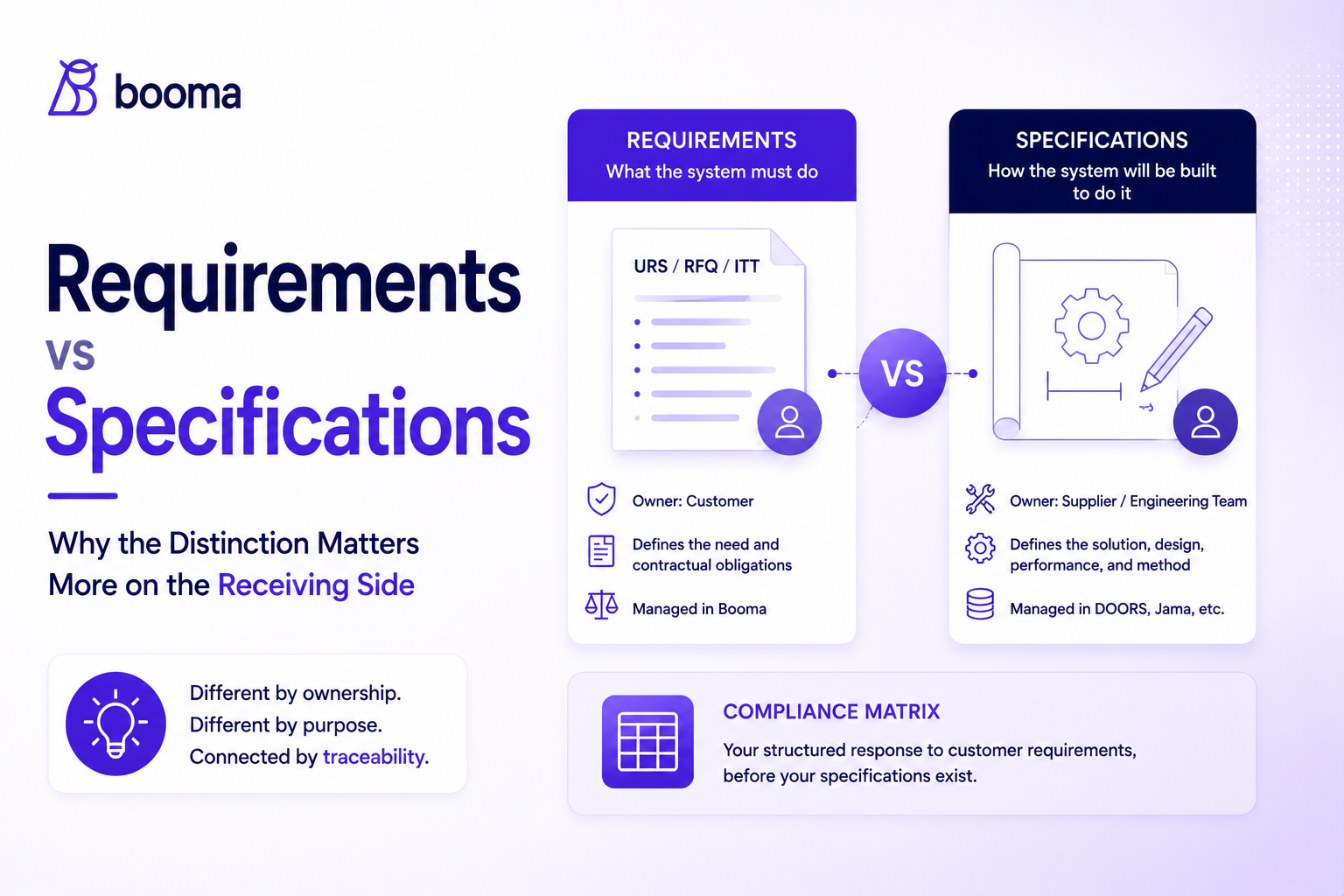
Es unterteilt sich in zwei verschiedene Disziplinen, die sich zufällig den gleichen Namen teilen. Das Anforderungsmanagement auf der Erstellerseite umfasst die Verwaltung der Anforderungen, die Ihr eigenes Unternehmen für sein eigenes Produkt schreibt. Das Anforderungsmanagement auf der Empfängerseite umfasst die Arbeit, Anforderungen, die Ihnen von Kunden übermittelt werden, zu verstehen und darauf zu reagieren.
Was ist der Unterschied zwischen Anforderungsmanagement auf der Erstellerseite und auf der Empfängerseite?
Auf der Erstellerseite ist das Ergebnis eine baselined Spezifikation. Auf der Empfängerseite ist das Ergebnis eine Compliance-Matrix. Die Erstellerseite verwaltet Anforderungen durch V-Modell-Prozesse innerhalb einer Organisation. Die Empfängerseite verwaltet Anforderungen über Organisationsgrenzen hinweg, von der URS des Kunden über die Compliance-Antwort bis hin zur FAT-Abnahme. Die Fehlerarten, Zeitpläne und Werkzeuge unterscheiden sich.
Wie lässt sich Booma mit IBM DOORS, Jama oder Visure vergleichen?
Es handelt sich nicht um konkurrierende Produkte. DOORS, Jama und Visure sind für die Erstellerseite konzipiert. Booma ist für die Empfängerseite konzipiert. Unternehmen, die beides tun, nutzen in der Regel auch beides.
Was ist eine Compliance-Matrix?
Das strukturierte Ergebnis, das ein Lieferant als Antwort auf eine URS, eine Angebotsanfrage (RFQ) oder eine Ausschreibung (ITT) an einen Kunden zurückgibt. Jede Kundenklausel wird mit einem Compliance-Status (vollständig konform, teilweise konform, nicht konform oder nicht relevant), einem Nachweisverweis und gegebenenfalls einer Optionszeile mit Auswirkungen auf Kosten und Lieferzeit versehen. Die meisten B2B-Verträge für Ausrüstung und Integration werden auf Basis der Compliance-Matrix vergeben.
Welche Branchen nutzen das Anforderungsmanagement auf der Empfängerseite?
Industriemaschinen, Verpackungsanlagen, Intralogistik, Flughafen-Gepäckabfertigung, Automobilzulieferer (Tier-1), Batterie- und Energiesysteme, Lieferketten in Verteidigung und Luftfahrt, Schienen- und Verkehrsinfrastruktur, EPC-Engineering sowie pharmazeutische Anlagen, unter anderem.
Wie verbessert KI die Empfängerseite?
Sie automatisiert die Schritte, die bisher den Großteil der Engineering-Zeit in Anspruch nahmen: das Extrahieren jeder Klausel aus einem langen Dokument, das Vorschlagen von Compliance-Antworten basierend auf früheren Angeboten, der Abgleich von Dokumentenrevisionen zur Identifizierung von Änderungen und die Handhabung von URS-Dokumenten in mehreren Sprachen. Ingenieure verlagern ihren Fokus von der manuellen Transkription hin zur strukturierten Überprüfung und Bewertung.
[NEXT STEPS]
Möchten Sie sehen, wie der neunschrittige Workflow auf der Empfängerseite in der Praxis funktioniert?
Der Leitfaden zum Anforderungsmanagement-Prozess führt durch den gesamten Workflow, vom Eingang einer URS bis zur Einreichung der Compliance-Matrix und dem, was nach dem Zuschlag passiert.
Müssen Sie die Rückverfolgbarkeit über den gesamten Lebenszyklus vom Angebot bis zur FAT verstehen?
Der Leitfaden zur Anforderungsrückverfolgbarkeit erläutert, warum die Rückverfolgbarkeit auf der Empfängerseite schwieriger ist als auf der Erstellerseite, was die RTM auf der Empfängerseite tatsächlich enthält und wie die Kette ohne eine speziell dafür entwickelte Software zur Pflege zerfällt.
Möchten Sie Booma in Aktion sehen?
Entdecken Sie Boomas Software für Anforderungsmanagement → um zu sehen, wie sie die Empfängerseite handhabt, oder buchen Sie eine Demo um die Situation Ihres Teams direkt zu besprechen.

.png)