.svg)
Introduction
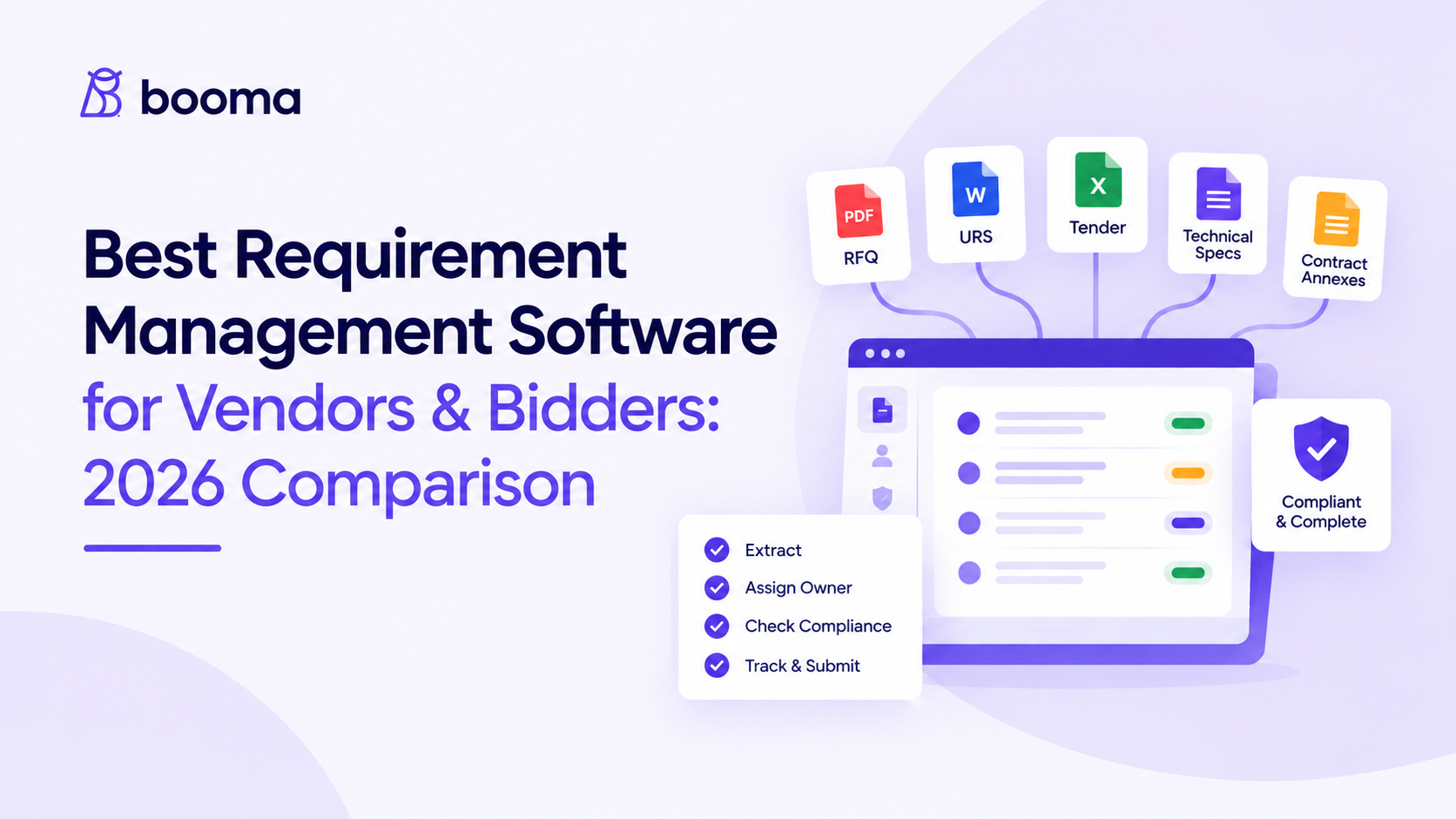
Most requirement management software was built for teams that create and own requirements during product development. Vendors, system integrators, EPCs, and bid engineering teams work from the other side: they receive RFQs, URSs, ITTs, tenders, technical specifications, and contract annexes from customers.
Their challenge is not simply writing requirements. It is extracting every customer requirement, assigning the right internal owner, assessing compliance, managing clarifications and revisions, and ensuring nothing is missed before submission.
That is why the best requirement management software depends on your workflow. A product-development team may need lifecycle traceability between requirements, design, testing, and release. A bidder needs to turn incoming specifications into a complete, controlled, and auditable response.
This guide compares requirement management software, RFP response platforms, and tender tools from the perspective of receiving-side requirements management: the vendor responding to customer requirements.
[KEY TAKEAWAYS]
- Most traditional requirement management platforms are strongest for authoring-side engineering: teams that create, develop, verify, and validate their own requirements
- RFP response tools are strongest for drafting, answer libraries, and proposal collaboration, but may not provide detailed requirement-level compliance tracking.
- Tender and bid-management platforms help manage pipeline, deadlines, invitations, and submissions, but often do not manage the detailed requirements inside a specification.
- Booma.ai is designed for the receiving side: extracting customer requirements, assigning owners, tracking compliance, comparing document versions, and creating a traceable response workflow.
- Many vendor teams benefit from a connected stack of tools rather than forcing one platform to manage requirements, proposal drafting, tender tracking, and collaboration equally well.
Best Tools at a Glance
[TABLE]
Tool
- Booma.ai
- IBM DOORS
- Jama Connect
- Polarion
- Visure
- Jira
- Azure DevOps
- Loopio
- Responsive
- Arphie
- Inventive AI
- AutoRFP.ai
- PlanHub / Procore
Category
- Requirements intelligence
- Requirements management
- Requirements management
- ALM and requirements management
- Requirements management
- Work management
- DevOps and work management
- RFP response software
- RFP response software
- AI RFP response software
- AI RFP response software
- AI RFP response software
- Tender and bid management
Best For
- Engineering vendors handling complex RFQs, URSs, and tenders
- Regulated engineering and systems development
- Product and systems engineering
- Engineering lifecycle management
- Safety-critical and compliance-heavy industries
- Flexible internal tracking workflows
- Software-development requirements
- Mature proposal teams with content libraries
- Enterprise response programmes
- Source-backed AI drafting and collaboration
- Connected knowledge and proposal automation
- AI-assisted RFP drafting
- Construction tender workflow and bid tracking
Receiving-Side Fit
- High
- Low to medium
- Low to medium
- Low to medium
- Low to medium
- Medium, with configuration
- Medium, with configuration
- Medium
- Medium
- Medium
- Medium
- Medium
- Medium
What Vendors Need From Requirement Management Software
For a vendor, requirements management starts when a customer sends a document. That document may contain hundreds or thousands of requirements across technical specifications, drawings, commercial terms, standards, annexes, and referenced files.
For a closer look at the workflow behind this approach—from document intake through to a completed compliance matrix—read our guide to the requirements management process for receiving-side teams.
A receiving-side team typically needs to:
- Extract requirements from PDFs, Word files, spreadsheets, and technical annexes.
- Break compound clauses into individual, actionable requirements.
- Keep every requirement linked to its original source location, creating the requirements traceability needed to explain how each response connects back to the customer’s specification.
- Classify requirements by type, priority, discipline, and commercial or technical risk—so the team can prioritise requirements in a bid before critical deadlines are at risk.
- Assign requirements to engineering, sales, legal, quality, controls, safety, and commercial owners.
- Track status, compliance, clarifications, and evidence.
- Identify what changed between document versions.
- Build a compliance matrix with supporting evidence that can be reviewed before submission and reused during project handover.
For vendors, the challenge is not writing requirements. It is turning a customer’s specification into a complete, owned, and traceable response.
Requirement Management vs RFP vs Tender Tools
[TABLE]
Category
- Requirement management software
- RFP response software
- Tender or bid-management software
Main purpose
- Structure, trace, assign, assess, and manage requirements
- Create and manage answers to RFPs, RFIs, DDQs, and questionnaires
- Manage opportunities, deadlines, invitations, and submissions
Typical strengths
- Traceability, ownership, change control, compliance
- Content library, AI drafting, reviewer workflow
- Bid pipeline visibility and coordination
Typical limitation for vendors
- Traditional tools often assume authoring-side engineering
- Often stronger at answers than at requirement-level compliance
- Usually does not manage every technical requirement in the tender
If requirements are buried in long documents and your team misses clauses, start with a receiving-side requirement management workflow. If your biggest issue is finding approved answers from previous proposals, RFP response software may be the priority. If deadlines and bid invitations are difficult to control, a tender platform can help.
Best Requirement Management Software for Vendors
1. Booma.ai
Category: Requirements intelligence platform
Best for: Engineering companies, system integrators, equipment manufacturers, EPCs, automation businesses, and suppliers responding to complex specifications.
Booma.ai is built for the receiving side of requirements management. It helps teams upload customer documents, extract and structure requirements, assign owners, track compliance, compare document versions, and reuse cross-project knowledge.
Strengths
- Designed specifically for vendor and bidder workflows.
- Extracts and structures requirements from customer documents.
- Enables owner assignment and collaboration at requirement level.
- Supports compliance tracking and evidence capture.
- Helps identify changes across document revisions.
- Supports traceability from source requirement to internal response.
Considerations: Best suited to teams receiving complex external requirements, rather than teams only managing internal product backlogs.
Choose Booma.ai if: your team receives complex customer specifications and needs stronger control over extraction, ownership, compliance, change tracking, and traceability. See Booma’s requirements intelligence platform.
2. IBM Engineering Requirements Management DOORS
Category: Enterprise requirements management
Best for: Aerospace, defence, automotive, rail, and other regulated engineering programmes.
IBM DOORS is a well-established requirements management platform for complex systems engineering. Its core strength is formal traceability across requirements, design, verification, and validation.
Strengths: Mature traceability, formal requirements hierarchies, and change control.
Considerations for vendors: Can be heavyweight for bid teams and is more aligned with authoring-side systems engineering than tender intake.
Choose IBM DOORS if: your organisation primarily manages requirements across long, highly regulated product or systems-engineering lifecycles.
3. Jama Connect
Category: Requirements, risk, and test management
Best for: Product and systems engineering teams.
Jama Connect is commonly used to manage requirements, risk, testing, and traceability across regulated product-development programmes. It provides strong lifecycle governance, but vendors should evaluate whether it supports tender intake, routing requirements to bid stakeholders, and producing a complete compliance response.
Strengths: Connects requirements, risk, test, and release activities.
Considerations for vendors: More suited to internally authored requirements and may need custom configuration for bid workflows
4. Polarion
Category: Application lifecycle management and requirements management
Best for: Engineering organisations with integrated development, testing, and lifecycle workflows.
Polarion supports requirements alongside development, testing, change control, and project collaboration. It is strong when requirements need to remain connected to the product lifecycle.
Strengths: Lifecycle traceability and integration with engineering and test management.
Considerations for vendors: Not purpose-built for RFQ, URS, or tender intake; may be excessive for a focused bid-engineering workflow.
5. Visure
Category: Requirements management and traceability
Best for: Safety-critical and compliance-heavy engineering environments.
Visure focuses on requirements management, traceability, compliance, and risk. Its formal approach is valuable when evidence and auditability are essential.
Strengths: Strong traceability and compliance orientation.
Considerations for vendors: More aligned with engineering and compliance programmes than fast tender-document intake and response workflows.
6. Jira and Azure DevOps
Category: Work management / DevOps
Best for: Teams that already use Atlassian or Microsoft development tools and are willing to configure workflows.
Jira and Azure DevOps can work as assignment and tracking layers after requirements are already structured. Neither inherently solves the document-intelligence problem of identifying and atomising hundreds of requirements from a customer specification.
Strengths: Flexible workflows, ownership, dashboards, and integrations.
Considerations for vendors: Require setup and governance; typically need complementary tools for extraction, source traceability, and compliance matrices.
7. Loopio
Category: RFP response software
Best for: Mature proposal teams with governed content libraries.
Loopio helps teams respond to RFPs, RFIs, DDQs, and questionnaires. Its primary value is content libraries, contributor workflows, approvals, and AI-supported response drafting.
Strengths: Mature proposal workflow, governed answer library, and AI-assisted drafting.
Considerations for vendors: Stronger in response content than technical requirement management; success depends on maintaining a high-quality content library.
8. Responsive
Category: Enterprise RFP response software
Best for: Large organisations handling RFPs, RFIs, DDQs, security questionnaires, and multi-team response programmes.
Responsive, formerly RFPIO, supports enterprise response management with content libraries, collaboration, AI document analysis, workflow automation, and integrations.
Strengths: Broad enterprise response-management capabilities and cross-functional collaboration.
Considerations for vendors: Its primary value lies in response management; assess carefully for source-clause traceability and complex technical compliance use cases.
9. Arphie, Inventive AI, and AutoRFP.ai
Category: AI RFP response software
Best for: Teams that need faster drafting, source-backed answers, connected knowledge, and proposal collaboration.
Arphie focuses on source-backed AI answers and proposal collaboration. Inventive AI connects knowledge sources to RFP response workflows. AutoRFP.ai focuses on AI-assisted drafting, semantic search, and content-review workflows.
These tools can accelerate response creation and retrieve reusable knowledge. They do not necessarily replace a dedicated workflow for managing technical requirements, requirement ownership, compliance decisions, document revisions, and source evidence.
AI RFP tools can speed up drafting, answer retrieval, and collaboration. However, teams should distinguish between generating an answer and validating compliance against the customer’s original clause. For more on the drafting side of the workflow, see our guide to automating RFP responses with AI.
10. PlanHub, Procore, and Tender Platforms
Category: Tender and bid management
Best for: Construction and project-based teams managing bid opportunities, invitations, deadlines, and submissions.
Tender platforms help teams find and manage bid opportunities, organise tender packages, track deadlines, invite collaborators, and coordinate submissions.
Strengths: Bid pipeline visibility, deadline tracking, and bid-package coordination.
Considerations for vendors: They generally do not structure and track every technical requirement inside a tender document.
A tender platform can tell you which bid is due next. Requirement management software helps ensure you understand—and can prove your response to—what the customer actually asked for.
How to Choose the Right Tool
Choose receiving-side requirement management software if:
- Your team receives long, complex RFQs, URSs, ITTs, or tender packs.
- Requirements are manually copied into Excel.
- Clauses are missed during bid preparation.
- Ownership of individual requirements is unclear.
- Document revisions create major rework.
- You cannot easily prove how a response relates to the original customer requirement.
- Compliance matrices are created late or maintained manually.
Choose RFP response software if:
- Your team understands the requirements but drafts responses too slowly.
- Approved answers are scattered across drives, wikis, and previous proposals.
- You need a governed content library.
- Your response volume is high and questions repeat frequently.
Choose tender or bid-management software if:
- Your main issue is tracking bid opportunities and deadlines.
- You need control over invitations, bid packages, or submission status.
- Your business operates in construction or another project-based tender environment.
A practical stack may include Booma.ai for requirements and compliance, an RFP platform for drafting and content governance, and a tender platform for opportunity and submission tracking.
[FAQ]
What is requirement management software?
Requirement management software helps teams capture, structure, assign, track, trace, and manage changes to requirements. For vendors, this includes requirements received in RFQs, URSs, tenders, and technical specifications.
For a fuller explanation of this vendor workflow, read our guide to receiving-side requirements management.
What is the difference between requirement management software and RFP software?
Requirement management software focuses on the customer requirement itself: its source, owner, status, risk, compliance, and evidence. RFP software focuses more on drafting answers, managing content libraries, collaborating on proposals, and routing approvals.
If your main goal is speeding up drafting and answer retrieval, see how to automate RFP responses with AI.
How does the compliance matrix relate to requirements and specifications?
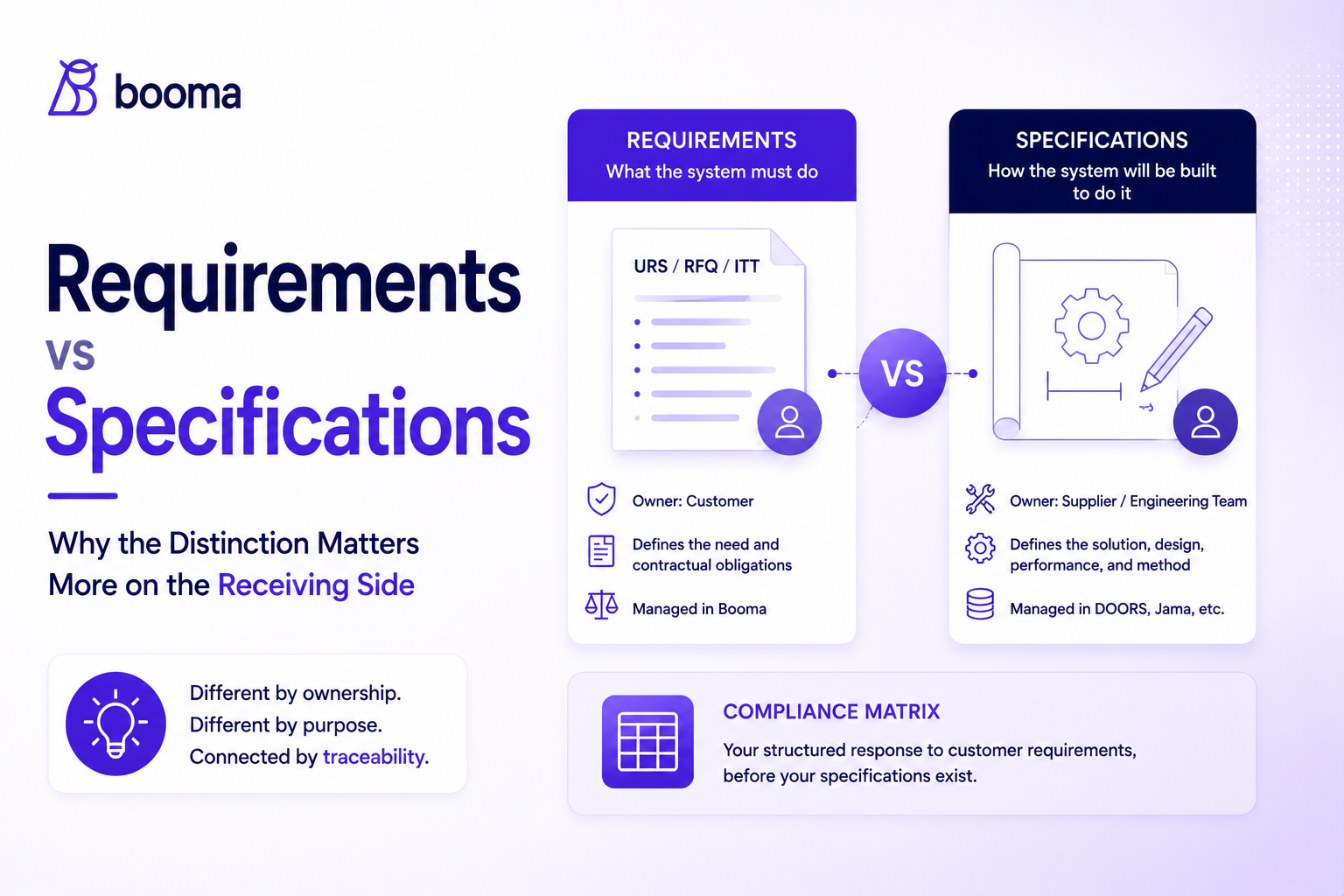
The compliance matrix is your structured response to customer requirements. It operates at the requirements level: it addresses each customer clause without yet defining how your engineering will meet it. Your internal specifications are the evidence that substantiates the compliance claims in the matrix.
Can vendors use Jira or Azure DevOps for requirement management?
Yes, but both usually require configuration and complementary processes. They can track tasks and owners, but they are not purpose-built for extracting requirements from tender documents, comparing specification revisions, or building compliance matrices.
Do vendors need both Booma and RFP response software?
Not always. If your main challenge is analysing complex technical specifications and proving compliance, start with Booma. If your main challenge is drafting repetitive answers from a large content library, an RFP response tool may be useful too.
Larger teams may use both: one platform for requirements and compliance, another for proposal drafting and content governance.
What should vendors look for in requirement management software?
Look for requirement extraction from customer documents, source traceability, owner assignment, compliance status per requirement, risk and clarification tracking, revision comparison, collaboration, an audit trail, exportable compliance matrices, and the ability to reuse knowledge across past bids.
For deeper guidance, see why requirements traceability and a compliance matrix with supporting evidence matter for receiving-side teams.
[NEXT STEPS]
If your team still manages customer requirements through spreadsheets, email, shared folders, and manual compliance matrices, start with a real document, not a generic demo dataset.
See how Booma's requirements management software extracts requirements from an RFQ, URS, or technical specification, assigns ownership, tracks compliance, and highlights changes between document versions.
Want to see what that looks like in a real engineering environment? Read the Lödige Industries case study.
Ready to evaluate the workflow with one of your own specifications? Book a demo.

.png)