.svg)
Introduction
Most guides to the requirements management process describe the same starting point: a stakeholder workshop, a blank requirements document, and a systems engineer who owns the whole chain from day one.
That is not where most requirements management work actually starts.
For bid engineers, proposal managers, sales engineers, and system integrators, the process starts when a document arrives. A 400-page URS from a customer who expects a structured compliance response in six weeks. A revised ITT that changes seventeen clauses two days before submission. A supply quality manual from a new platform OEM that adds obligations to a programme already in build.
“We’ve seen teams with strong engineers and clear product capability still lose bids, or worse, win them and struggle at FAT, because the process of handling the incoming document was never structured. The requirements were in there. Nobody had a reliable way to get them out.”
— Kareem Bayoun, CEO, Booma
Without a repeatable process, every new URS starts from scratch. The same extraction mistakes recur. The same compliance gaps appear. The same knowledge walks out the door when someone leaves.
This article covers what the receiving-side process actually looks like, where it breaks down, and how purpose-built tooling changes the economics of running it.
[KEY TAKEAWAYS]
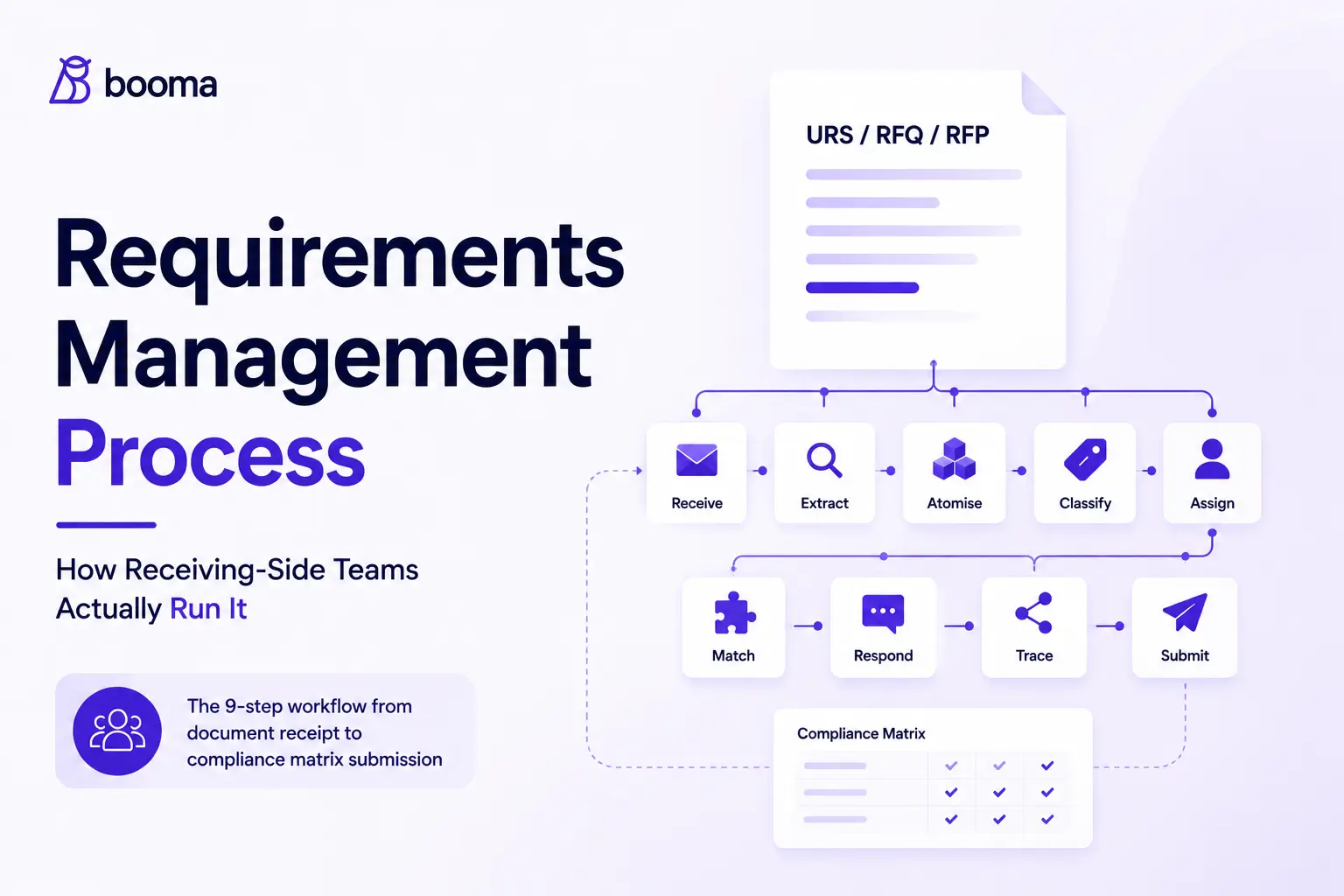
- The receiving-side requirements management process runs nine steps: Receive, Extract, Atomise, Classify, Assign, Match, Respond, Trace, Submit.
- Most bid engineering teams run this process manually in Excel, which means it gets slower and less reliable as bid volume rises.
- The failure modes, missed clauses, fragmented evidence, stale compliance responses, and traceability decay, almost always trace back to the same root cause: no repeatable process, so each bid reinvents the wheel.
- A structured process with the right tooling does not just speed up individual bids. It builds a compliance knowledge base that makes every subsequent bid in a customer family faster and more accurate.
- AI automates the steps that drain the most engineering time: extraction, classification, compliance suggestion, and revision diffing.
What Is the Receiving-Side Requirements Management Process?
Put simply, it is the workflow a team runs from the moment a customer document arrives to the moment a compliance matrix goes back. Everything in between: extraction, classification, internal routing, compliance drafting, version control, and submission, is the process.
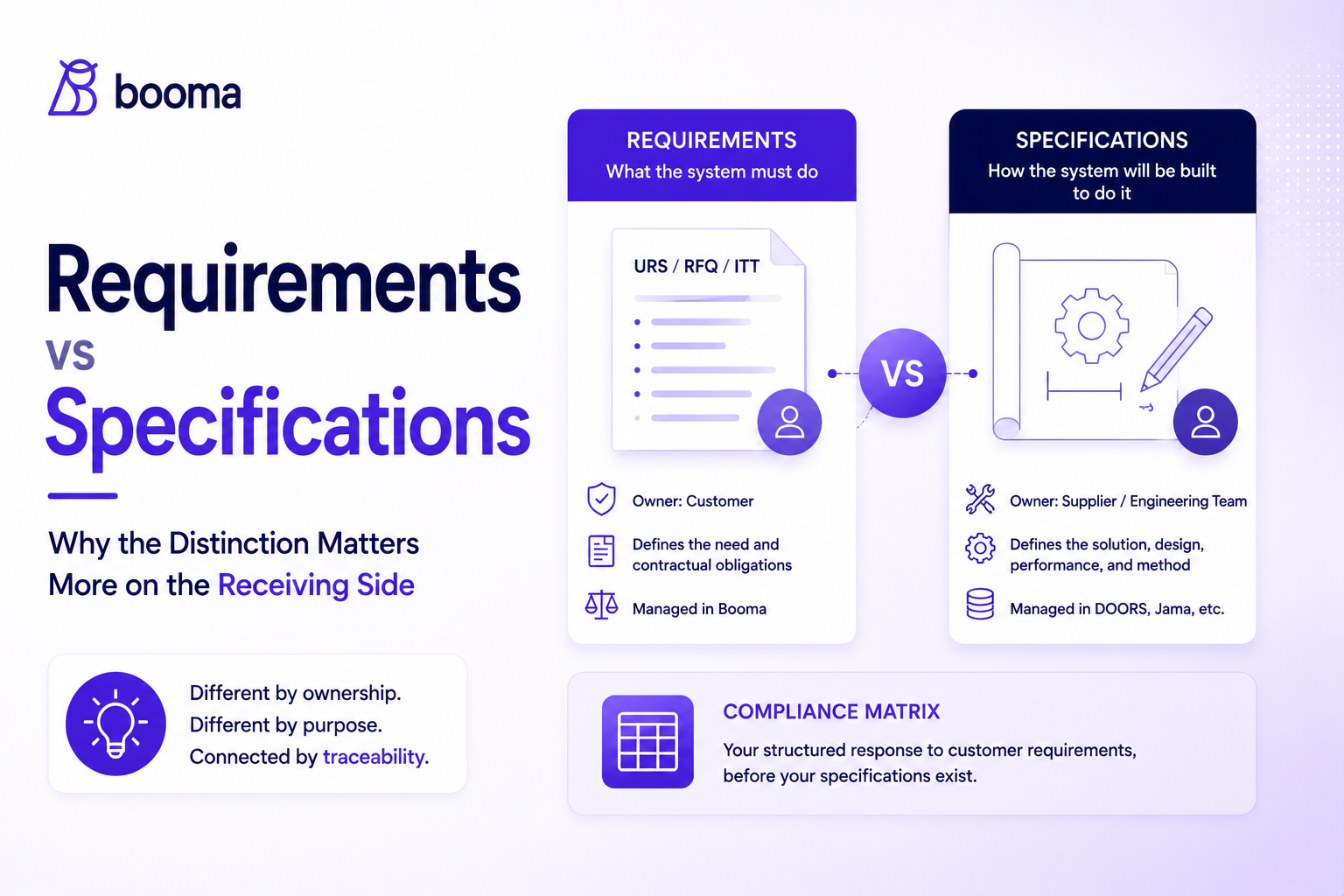
It is not the same process described in systems engineering textbooks. Those describe how a team manages requirements they wrote themselves, through design, verification, and validation. Useful work. A different job.
The receiving-side process manages requirements someone else wrote and sent to you. Your job is to understand every clause, assess whether your product or solution meets it, assign it to the right people, draft a defensible response, and maintain an auditable record of that response from bid submission through FAT and beyond.
Most teams running this process today do it in some combination of Excel, email, and shared drives. It works up to a point. That point is usually somewhere around the third concurrent bid, or the first time a key person leaves and the compliance knowledge leaves with them.
Why a Structured Process Matters More Than Most Teams Think
An unstructured process does not feel broken until it is. Bids get submitted. Contracts get won. Equipment gets built and delivered. The failure modes are slow and invisible.
A clause gets missed on page 247 of a URS and nobody knows until the FAT script surfaces it eighteen months later. A compliance response that was valid for a similar bid twelve months ago gets copy-pasted into a new one without checking whether the product capability still matches. A customer issues URS Revision 4 and the team spends three days working out which of their responses need updating instead of knowing immediately.
None of these failures show up on a bid submission dashboard. They show up as retrofit costs, dispute resolution, and margin erosion on projects that looked clean at award.
“The process problem we see most often isn’t that teams are careless. It’s that they built the process around one or two senior people who know where everything lives. When those people are overloaded or unavailable, the process stops.”
—Kareem Bayoun, CEO, Booma
A structured process means the knowledge lives in a system, not in one person’s head. The tenth bid in a customer family takes a fraction of the time the first did. A new hire can pick up an active bid without spending their first month shadowing the most experienced person on the team.
How the Receiving-Side Process Works
Step 1: Receive
A customer-issued document arrives: URS, RFQ, ITT, tender, technical specification, or contract addendum. The first job is not reading it. It is capturing it: customer name, opportunity reference, document version, language, submission deadline, and the name of whoever owns the response. Documents that land in an inbox without being formally registered get lost in the shuffle. On a team managing fifteen active bids, that happens more than anyone admits.
Step 2: Extract
Every requirement clause gets pulled out of the document. A 300-page URS typically contains between 400 and 1,500 distinct requirements, buried across prose paragraphs, tables, footnotes, figure callouts, and annexes. Manual extraction is the single biggest time sink in the process. It takes days, it is bounded by human attention, and it misses things. AI extraction takes minutes and does not get tired at page 180.
Step 3: Atomise
Compound requirements get split into atomic statements. A clause that says “the system shall operate at 1.2 m/s and be CE-marked per Machinery Directive 2006/42/EC” is two requirements. Skip atomisation and you end up assessing compliance at the wrong granularity: a clause marked Fully Compliant when you actually comply with one part and have a gap in the other.
Step 4: Classify
Each atomic requirement gets tagged: type (functional, performance, safety, regulatory, interface, commercial, environmental, documentation), criticality, source location (page and paragraph), and any referenced standards. Classification is what makes the rest of the process manageable. Without it, a 600-clause URS is just a list. With it, you can filter for every regulatory clause, every safety requirement, every interface obligation, and route each group to the right team.
Step 5: Assign Internal Owners
Requirements get routed to the internal teams responsible for responding to them. A battery line URS might split across bid engineering, process engineering, controls, end-of-line test, quality, functional safety, and cybersecurity. Each team owns their slice. Bid engineering owns the consolidated view and the deadline.
The failure mode here is routing by forwarding an email with a spreadsheet attached. When eight teams are working in eight separate files, the consolidated matrix at the end is an assembly job, not a collaborative output.
Step 6: Match Against Capability
Each clause gets matched against the company’s standard product capability, engineered-to-order options, and prior compliance responses from similar bids. This is where a compounding knowledge base pays off. The third time a team responds to clauses from the same platform OEM, most of the matching should already be done. The tenth time, it should be nearly automatic.
Step 7: Draft Compliance Response
For each clause, the team writes a response: Fully Compliant, Partially Compliant with a named option and commercial delta, Non-Compliant with principled rejection or engineering study scope, or Not Relevant. Every response references internal evidence: a section of the standard product specification, a prior bid response, a test report, a drawing.
Responses without evidence references are compliance opinions, not compliance statements. They do not hold up at FAT.
Step 8: Trace and Version Control
Every clause keeps a thread back to its source: the page and paragraph in the customer document, the internal evidence used to answer it, and the compliance response itself. When the customer issues a revision, the process needs to surface which clauses changed and which responses are affected, automatically, not manually.
Customer revisions during a bid window are the rule, not the exception. A process that treats them as edge cases will fail on the bids that matter most.
Step 9: Submit and Retain
The consolidated compliance matrix gets exported and submitted. The underlying documentation gets retained, not archived and forgotten, but actively maintained as the evidentiary record that will be referenced at FAT, SAT, and any post-acceptance dispute that surfaces years later.
Most teams treat submission as the end of the process. It is not. It is the start of an eighteen-month audit window.
Common Failure Modes
No standard intake process
Documents arrive in inboxes, on portals, sometimes in physical post. Without a standard intake step, document versions get confused, deadlines get missed, and the wrong revision becomes the basis for the compliance response.
Extraction done by the most senior person available
Manual extraction defaults to whoever knows the product best, usually a principal engineer or bid manager who should be spending their time on technical judgement, not reading PDFs. When that person is overloaded, extraction becomes the bottleneck that holds up the whole bid.
Compliance responses that cannot be verified
A response gets submitted. Eighteen months later, the FAT engineer asks for the evidence behind it. Nobody can find the source. The original bid file is on a laptop that was replaced. The engineer who wrote the response left six months ago.
Revision management by comparison
When URS Rev 4 arrives, the team compares it manually to Rev 3, paragraph by paragraph, to identify what changed. On a 400-page document, this takes days. The compliance responses that need updating are identified by memory and manual cross-referencing, not by a system that knows which clauses changed and which responses are linked to them.
Knowledge that walks out the door
The most experienced bid engineers carry the compliance knowledge for their customer relationships in their heads. When they move on, every new bid in that customer family starts closer to zero than it should.
Benefits of a Structured Receiving-Side Process
[TABLE]
Benefit
- Faster intake to first-draft matrix
- Higher clause coverage
- Compounding knowledge base
- Controlled revision management
- Audit-ready evidence chain
- Process resilience
What it means in practice
- EuroSort reduced per-project processing from 52 hours to 8 hours after implementing a structured process with Booma.
- A structured extraction step, especially with AI support, catches requirements manual reading misses. CIMC Pteris achieved 100% requirement visibility across their incoming specifications.
- Prior compliance responses surface automatically against new clauses. The process gets faster with every bid in a customer family.
- Revisions are diffed automatically. Affected responses are flagged immediately, not discovered the day before submission.
- Every clause links to source, evidence, and response from day one. The chain survives from bid submission through FAT and SAT.
- When key people are unavailable or leave, the knowledge stays in the system. A new hire can pick up an active bid without starting from scratch.
Real-World Example
Lödige Industries builds and installs air cargo terminal systems for airports worldwide. Their projects involve large customer specifications, multiple engineering workstreams, and delivery schedules where a missed requirement can cascade into rework that costs more than the margin on the contract.
Before Booma, their process had a structural vulnerability: one person handled all requirement extraction from customer documents. Every bid started with that person reading through hundreds of pages before anyone else could begin. When they were on another project, or on leave, the whole intake process waited.
After implementing Booma, Lödige restructured the intake step entirely. Requirements are now extracted automatically from customer documents and organised into a centralised repository that all departments can access from day one. The extraction bottleneck is gone. Reviews start earlier. When a customer issues a change mid-project, the impact is visible immediately rather than after days of manual cross-referencing.
Jakob Müller, Project Manager at Lödige Industries: “What convinced us most was the immediate and noticeable relief in handling complex and numerous customer requirements through automated extraction.”
The process did not change fundamentally. The step that did not need to be manual stopped being manual.
What AI Actually Changed
Most teams doing this manually hit the same wall: the process works fine for a handful of bids a year, then stops working when bid volume doubles and the documents get longer.
Extraction is now reliable at scale. Models that combine text and layout understanding pull atomic requirements from 300-page PDFs at above 99 per cent accuracy. Extraction that used to take two days takes under an hour.
Compliance suggestion works well enough to change the nature of the job. Booma matches new clauses against a company’s prior bid history and surfaces the most similar prior response with a similarity score, the justification, and the compliance verdict. Engineers review and refine a suggested answer rather than drafting from scratch. The first bid in a customer family still takes full effort. By the fifth, most of the work is review.
Revision diffing is now instant. When a customer issues a new document version, the changed clauses are identified automatically and the affected compliance responses are flagged for review. What used to add days to an already tight deadline now adds minutes.
[TABLE]
Traditional
- Manual extraction over several days
- Compliance responses drafted from scratch
- Revision changes identified by manual comparison
- Knowledge in people’s heads
AI-Powered
- Automated extraction in under an hour
- AI-suggested responses based on prior bids, with similarity scoring
- Automatic diff with affected responses flagged immediately
- Compounding knowledge base accessible to the whole team
How Booma Helps
Booma is built around the receiving-side process. Not as a general-purpose requirements tool that happens to have an import function, but as a platform where the nine steps described in this article are the product.
When a customer document comes in, Booma pulls every clause out of it automatically, in PDF or Word or Excel, in whatever language the customer sent it in. Requirements buried in prose, tables, footnotes, and cross-referenced annexes come out classified and tagged, not dumped into a flat list. From there, they route to the right internal teams, each of whom works in the same environment rather than in a separate spreadsheet that someone has to merge later.
As teams build up bid history in Booma, the compliance suggestion capability gets more useful. Prior responses surface against new clauses. Engineers stop spending the first week of every bid rebuilding context they already built six months ago on a similar project.
The thread from source clause to compliance response to submitted matrix stays intact, automatically, from the day the document comes in through FAT and SAT and whatever comes after.
Booma is hosted in Germany, ISO 27001 certified, GDPR-compliant, and does not use customer data to train AI models.
[FAQ]
What is the receiving-side requirements management process?
It is the structured workflow a bid engineering or supply engineering team runs from document receipt through compliance matrix submission and post-award audit. The nine steps are: Receive, Extract, Atomise, Classify, Assign, Match, Respond, Trace, Submit.
How is this different from the requirements management process described in systems engineering literature?
Systems engineering literature describes the authoring-side process: how a team manages requirements they wrote for their own product through design and verification. The receiving-side process manages requirements someone else wrote and sent to you. The deliverable is a compliance matrix, not a baselined specification.
Why do most teams still run this in Excel?
Because no purpose-built software existed for the receiving side until recently. DOORS, Jama, and Polarion were built for the authoring side. Excel filled the gap and became entrenched. The cost of staying in Excel gets more visible as bid volume rises and document complexity increases.
What is the biggest single improvement a team can make to this process?
Fixing the extraction step. Manual extraction is the biggest time sink and the most common source of missed requirements. Automating it changes the economics of every subsequent step.
How does compliance suggestion work in Booma?
Booma matches new clauses against the team’s prior bid history and surfaces the most similar prior compliance response, with a similarity score and the original justification. Engineers review the suggested response and decide whether to accept, modify, or override it. Over time, as bid history builds, the proportion of clauses that need a fresh response from scratch gets smaller.
What happens to the compliance record after the bid is submitted?
In a structured process, it is retained as the evidentiary record for FAT, SAT, and post-acceptance disputes. Clause-level traceability connects each compliance commitment to the evidence used to support it, and that thread needs to survive the full project lifecycle, typically eighteen months to several years.
[NEXT STEPS]
Want to understand how traceability works across the full bid-to-FAT lifecycle?
The Requirements Traceability guide covers why the compliance evidence chain decays without active maintenance, what receiving-side traceability actually contains, and how to keep it intact across a project lifecycle measured in years, not weeks.
Working on how to structure and document compliance responses for audit?
The Requirements Documentation guide covers the compliance matrix as a deliverable: how to structure it, what evidence it needs to reference, and what makes it hold up under FAT scrutiny.
Want to see the process in action?
Explore the product → or book a demo to walk through how Lödige Industries, CIMC Pteris, and EuroSort run the receiving-side process with Booma.

.png)