.svg)
Requirements Traceability: What It Is, How It Works, and Why the Receiving Side Is Harder
Introduction
Requirements traceability is the chain of evidence connecting every requirement to every artefact that addresses, implements, and verifies it. Most articles describe it from one perspective: a systems engineer managing an internal chain from stakeholder need through specification through design through test, entirely within one organisation, in a tool like DOORS or Jama.
That chain is real and important. It is also not the hard version of the problem.
The harder version is the receiving side. A supplier receives a 400-page customer URS, extracts 900 clauses from it, assigns each to an internal team, drafts a compliance response, and submits a compliance matrix. The bid is awarded. Eighteen months later, the customer’s regulator asks about a specific safety commitment from page 187 of the original document. The engineer who made the original compliance decision left the company eight months ago. The compliance matrix is a frozen Excel file nobody has opened since submission.
“Traceability problems on the receiving side don’t surface during the bid. They surface at FAT, when the cost of not having the chain intact is at its maximum.”
— Anuraj Suman, Principal AI Engineer, Booma
That is the failure mode this article is about. The receiving-side traceability chain is longer than the authoring-side chain, it crosses organisational boundaries, and it has to survive eighteen to thirty-six months of personnel churn, customer-issued revisions, and tool changes before it is ever tested. Most teams are running it in Excel.
This article covers what receiving-side traceability actually requires, what a receiving-side RTM contains, why the chain decays, and how purpose-built software keeps it intact across the full bid-to-FAT lifecycle.
[KEY TAKEAWAYS]
- Requirements traceability documents every relationship between a requirement and the artefacts connected to it. It answers four questions: where did this come from, what does it touch, what drove a downstream artefact, and what breaks if this changes.
- On the authoring side, the traceability chain runs inside one organisation. DOORS, Jama, Polarion, and Visure are built for this.
- On the receiving side, the chain runs from a customer-issued source document through an extracted clause, through internal evidence, through a compliance response, through a submitted matrix, through an awarded contract, and through FAT and SAT test steps. It crosses organisational boundaries twice and spans 18 to 36 months.
- Traceability decay on the receiving side typically surfaces at FAT or SAT, when the cost of repair is highest.
- AI automates the three most common sources of decay: origin extraction, revision diffing, and cross-bid similarity scoring.
What Is Requirements Traceability?
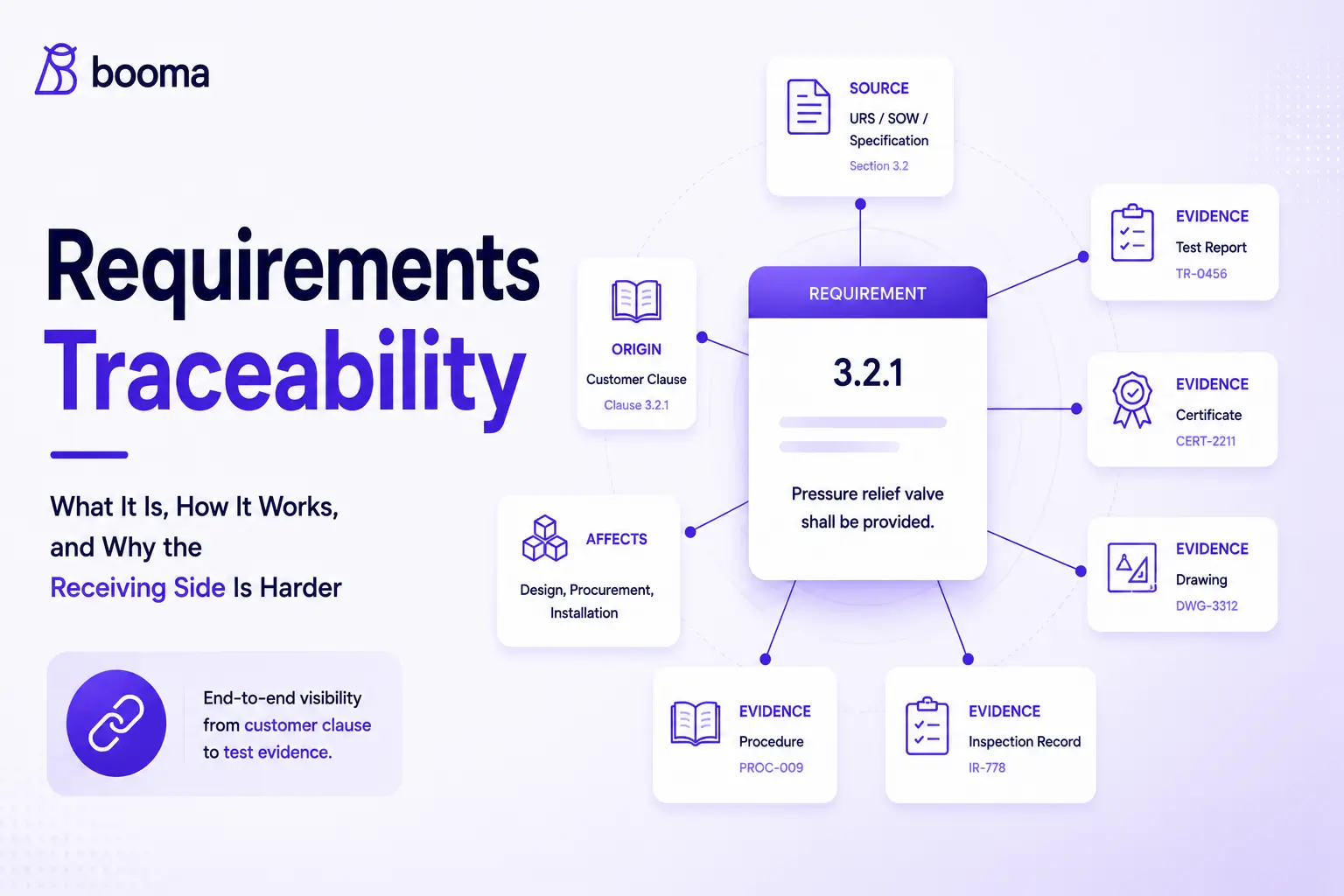
Traceability is the ability to follow a requirement in both directions: forward through every downstream artefact that addresses it, and backward from any downstream artefact to the requirement that drove it. Four questions define the scope:
- Where did this requirement come from? Origin traceability.
- What does it touch downstream? Forward traceability.
- What drove this design decision or test step? Backward traceability.
- What breaks if this requirement changes? Impact traceability.
On the authoring side, these questions are answered within a single engineering organisation. The chain runs from a stakeholder workshop through a URS through design documents through code through unit and integration tests. When something changes, the impact is contained. DOORS or Jama gives the systems engineer a queryable view across all of it.
On the receiving side, the chain is different. The source document is not something your organisation wrote. It is something a customer sent you. The destination artefacts include your compliance response, the customer-facing matrix, the awarded contract, your internal design and test documentation, the FAT test scripts, the customer’s SAT witness records, and any post-acceptance dispute documentation. Some of this lives in your systems. Some lives in the customer’s. The chain crosses the organisational boundary twice.
That structural difference is why receiving-side traceability is harder. It is not just longer. It is split across organisations that do not share databases, and it has to survive far longer than the authoring-side chain typically does.
The Receiving-Side Traceability Chain
Here is what the chain actually looks like when it is maintained properly, link by link.
Source document to source location. Every clause links back to the exact customer document, version, page, and paragraph it came from. Without page-and-paragraph specificity, every downstream link is vulnerable to drift. This is the foundation the rest of the chain sits on.
Source clause to atomic requirement. Where the customer issued a compound clause, the atomic split is recorded so the audit trail shows which atomic requirement traces back to which part of which compound statement. A clause marked Fully Compliant when only half of it was addressed is a liability at FAT.
Atomic requirement to classification. Type (functional, performance, interface, safety, regulatory, commercial, environmental), criticality flag, and source location. Classification drives routing and reporting and is itself part of the traceability record.
Atomic requirement to assigned internal team. The team responsible for the compliance response is named in the chain. Two years later, when the question is “who decided this and why,” the chain has an answer.
Atomic requirement to internal evidence. The compliance response cites internal evidence: a section of the standard product specification, a prior bid response, a test report, a capability statement. This is the most important link for audit defence. It is the answer to “what entitles you to claim compliance?”
Atomic requirement to compliance response. Compliance status (Fully Compliant, Partially Compliant, Non-Compliant, Not Relevant), free-text justification, and where applicable an option line with cost and lead-time delta.
Compliance response to customer-facing matrix entry. The submitted matrix entry is traceable to its underlying response, evidence, and source clause. The matrix is not a separate document. It is a view of the chain.
Matrix entry to awarded contract. When the bid is awarded, the compliance matrix typically becomes a contractual annex. Each row becomes a binding commitment.
Contract commitment to FAT and SAT test step. The FAT and SAT scripts reference specific contractual commitments. The traceability chain from source clause through contract commitment to FAT test step is what lets a supplier walk into factory acceptance with confidence that every commitment has a corresponding test.
Source clause to URS revision history. Every clause carries its revision history: when it was first introduced, when it last changed, what the previous version said, and which compliance responses were affected.
That is ten links per clause. In Excel, this is unmaintainable beyond a hundred clauses or two revisions. In purpose-built software, it is the default schema.
Why the Chain Decays
“The traceability chain that gets built during the bid and the chain that exists at FAT are rarely the same thing. The gap between them is where disputes live.”
— Anuraj Suman, Principal AI Engineer, Booma
Origin traceability is omitted at intake
The bid team extracts clauses but does not record the page and paragraph each came from. Eighteen months later, when a clause is disputed, nobody can locate it in the original document. Retrofitting page-and-paragraph references into a 900-clause matrix takes days and is still not as reliable as having captured them at intake.
Internal evidence references degrade silently
A compliance response cited Internal Specification IS-1234 Section 4.2 in 2024. By 2026, IS-1234 has been superseded by Revision 3 and Section 4.2 no longer covers what it used to. Without versioned evidence references, the link from compliance response to evidence rots without anyone noticing.
Customer revisions absorb without diff records
The customer issues URS Rev 4. The bid team updates their working matrix. Two months later, the customer asks which compliance responses changed since Rev 3. There is no diff record. The team reconstructs the answer manually by comparing two Excel files.
FAT scripts are written without reference to the RTM
Test engineering writes FAT scripts from the awarded contract without realising that every commitment is already linked in the RTM to source clauses and internal evidence. The result is duplicated effort and gaps where contractual commitments are not tested because nobody mapped the contract to the test plan.
Cross-bid learning does not transfer
The same clause appears in three different customer URS documents across two years. Each time, the bid team starts from scratch because there is no cross-bid traceability. The second and third responses are no better than the first, and the organisation does not get faster.
The people who built the chain leave
Eighteen months is long enough for significant team turnover. The engineer who decided the compliance response has moved on. Their reasoning is in their head, not in the chain. A new team member cannot reconstruct it from the Excel file.
What a Receiving-Side RTM Actually Contains
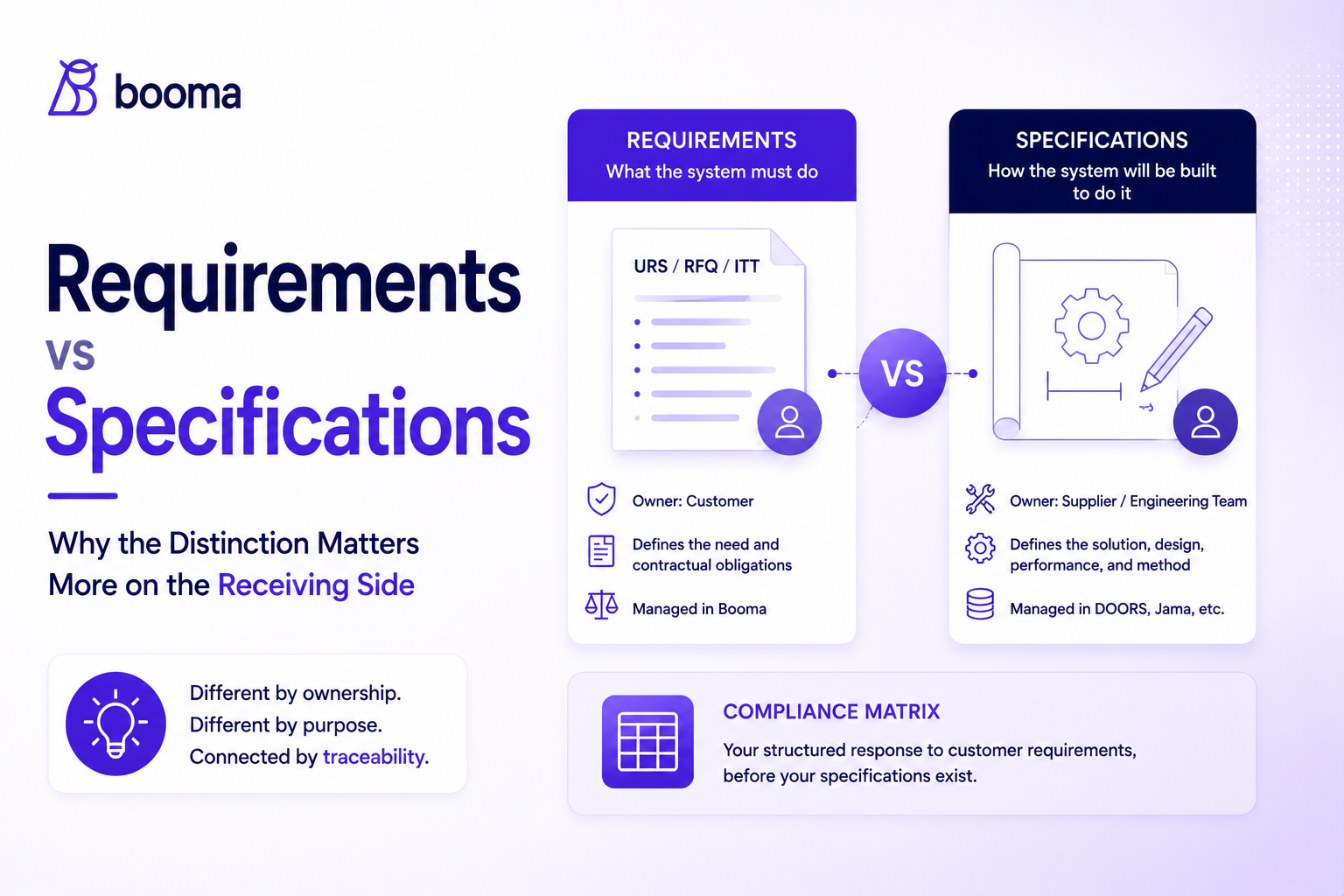
The compliance matrix submitted to the customer and the RTM are not the same artefact. This distinction is one of the most commonly confused points in receiving-side requirements management.
The compliance matrix is the customer-facing deliverable. Each row shows a customer clause and the supplier’s compliance status with a short justification. It is structured to the customer’s required format and submitted at bid.
The RTM is the supplier’s internal artefact. It produces the compliance matrix and adds everything else: source document and page, atomic clause text, classification metadata, internal team assignment, internal evidence references with version tracking, compliance response with full justification, option lines and commercial deltas, contract reference, FAT and SAT test step references, revision history, and dispute and change log.
A typical receiving-side RTM row has at minimum twenty columns. The compliance matrix is a five to eight column export from that row.
Maintaining them separately is the single most common cause of divergence between what was submitted and what the internal record shows. The compliance matrix should be a view exported from the RTM, not a parallel document.
Benefits of Getting Receiving-Side Traceability Right
[TABLE]
Benefit
- Audit defence in minutes, not days
- Revision management without manual diff
- Cross-bid compounding
- FAT readiness from day one
- Knowledge that outlasts personnel churn
- One record from intake through acceptance
What it means in practice
- A disputed compliance commitment at FAT is answered by querying the chain: source clause, decision, evidence, deciding engineer, date. CIMC Pteris can now answer change-request queries the same day instead of spending days tracing across documents.
- Customer-issued revisions are absorbed automatically. Affected compliance responses are flagged immediately, not discovered the day before submission.
- Prior compliance responses surface against new clauses with similarity scores. The tenth bid in a customer family is faster than the first by a measurable margin.
- The FAT test plan is derived from the RTM, not written from scratch. Every contractual commitment has a corresponding test step before FAT begins.
- The decision rationale, evidence references, and team assignments stay in the chain regardless of who is still at the company at FAT.
- The compliance matrix submitted and the RTM maintained after award are the same data. No divergence. No reconciliation.
Real-World Example
A European railway signalling supplier was tendering for the upgrade of a regional signalling network. The customer URS ran to 380 pages and 1,100 clauses, with extensive references to EN 50126, EN 50128, and EN 50129.
The bid was awarded. Eighteen months later, during FAT, the customer’s regulator raised a question about a specific safety commitment. The original URS clause specified emergency brake engagement within one second of stop signal receipt. The FAT script had tested only firmware-side actuation response time, not end-to-end latency including signal transmission. The supplier’s functional safety lead had decided during the original bid to interpret engagement as firmware-side actuation. The decision was technically defensible but contested.
What the regulator needed to assess the position: the original clause (URS Rev 2, page 187, paragraph 4.7.2), the compliance response, the internal evidence, the name and title of the deciding engineer, the date of the decision, and the FAT test step that implemented it.
Before the supplier had deployed purpose-built receiving-side software, a query like this would have taken three to four days of forensic investigation across Excel sheets, shared drives, departed employees’ inboxes, and handover decks. After deployment, the full chain was returned in two minutes from a single RTM query.
The regulator accepted the firmware-side interpretation on the basis of the documented decision rationale. FAT continued without delay.
The metric that mattered was not the two-minute query time. It was the fact that the supplier could defend a contested compliance position eighteen months after the fact with the same confidence as if the decision had been made yesterday.
What AI Changed
The chain used to decay because three things were unavoidably manual. None of them are anymore.
Source-page and paragraph extraction is now automated. Multi-modal models identify the exact page and paragraph from which every extracted clause originates, automatically and reliably at scale. The origin link no longer depends on a bid engineer annotating 900 clauses by hand.
Cross-bid similarity is computable. Embedding-based similarity surfaces clauses from prior bids that resemble a new clause, with scores precise enough to drive compliance suggestion. Cross-bid traceability no longer depends on a human remembering where they have seen a clause before.
Revision diffing is instant. Document version control combined with clause-level fingerprinting identifies which clauses changed, which were renumbered, which were merged, and which are new, on document upload. Revision absorption that used to add days to a bid window now takes minutes.
[TABLE]
Traditional
- Page and paragraph annotated manually
- Cross-bid similarity by memory
- Revision diff by manual document comparison
- Evidence references checked manually
AI-Powered
- Source location extracted automatically at intake
- Embedding-based similarity scoring across full bid history
- Automatic clause-level diff on version upload
- Versioned evidence links flagged when underlying documents change
How Booma Helps
Booma is built around the receiving-side traceability chain. Every step in the platform connects back to it.
Every clause Booma extracts from a customer document carries its source document, version, page, and paragraph automatically, from the moment of intake. Classification, criticality, and team assignment are part of the same record. The chain starts on the day the document comes in, not the week before FAT.
Compliance responses are linked to versioned internal evidence. When the underlying evidence document changes, affected responses are flagged rather than left to decay silently.
The customer-facing compliance matrix is exported from the RTM, not maintained separately. The matrix and the RTM stay in sync because they are views of the same data.
Customer-issued revisions are diffed automatically. Booma identifies which clauses changed, which compliance responses are affected, and which can carry forward. Diff records are preserved as part of the traceability history.
Cross-bid traceability works across every bid the team has ever run in Booma. A new clause is scored against the company’s full history of prior responses, surfacing the most similar ones, the engineers who decided them, and the evidence they cited.
FAT and SAT planning queries run directly against the RTM. The test plan is a derived view of the contractual commitments in the matrix, not a parallel artefact written in a separate tool.
DOORS and Jama maintain traceability for the requirements your engineering organisation authors. Booma maintains traceability for the requirements your customers impose on you. Plenty of organisations run both, because both chains exist in the same supply chain.
Booma is hosted in Germany, ISO 27001 certified, GDPR-compliant, and does not use customer data to train AI models.
[FAQ]
What is requirements traceability on the receiving side?
It is the chain of evidence connecting every customer-issued clause to its source location, the internal team that responded to it, the evidence cited, the compliance response submitted, the awarded contract commitment, and the FAT and SAT test steps that verify it. The chain has to survive from bid acceptance through acceptance testing, typically 18 to 36 months.
What is the difference between a compliance matrix and a traceability matrix?
The compliance matrix is the customer-facing deliverable: each row shows a customer clause and the supplier’s compliance status with a short justification. The traceability matrix is the supplier’s internal artefact that produces the compliance matrix and adds everything else: source page, evidence references, team assignments, version history, and test step links. The compliance matrix is a subset of the RTM, exported on submission.
Why is receiving-side traceability harder than authoring-side traceability?
Because the chain crosses organisational boundaries twice, spans 18 to 36 months, must survive personnel churn, has to absorb customer-issued revisions, and historically has been managed in Excel rather than in purpose-built software.
Do DOORS, Jama, or Visure support receiving-side traceability?
These tools are built for authoring-side traceability: the chain that runs inside a single engineering organisation managing its own product. The receiving-side chain, which includes the customer-facing compliance matrix and the awarded contract, has not been their target use case.
How does AI help with receiving-side traceability?
AI automates source-page and paragraph identification at extraction, similarity scoring against prior bids for cross-bid traceability, revision diffing between customer document versions, and flagging of compliance responses whose evidence has changed. These were all manual processes in spreadsheet-based traceability.
[NEXT STEPS]
Want to understand how traceability fits into the full nine-step receiving-side workflow?
The Requirements Management Process guide covers how traceability is established at intake and maintained through each step of the receiving-side process, from extraction through submission.
Need to understand how to document and structure the compliance matrix for audit?
The Requirements Documentation guide covers the compliance matrix as a deliverable: how to structure it, what evidence it needs to reference, and what makes it defensible eighteen months after submission.
Want to see receiving-side traceability in action?
Explore the product → or book a demo to see how Booma maintains the traceability chain from URS intake through FAT and beyond.

.png)