.svg)
Introduction
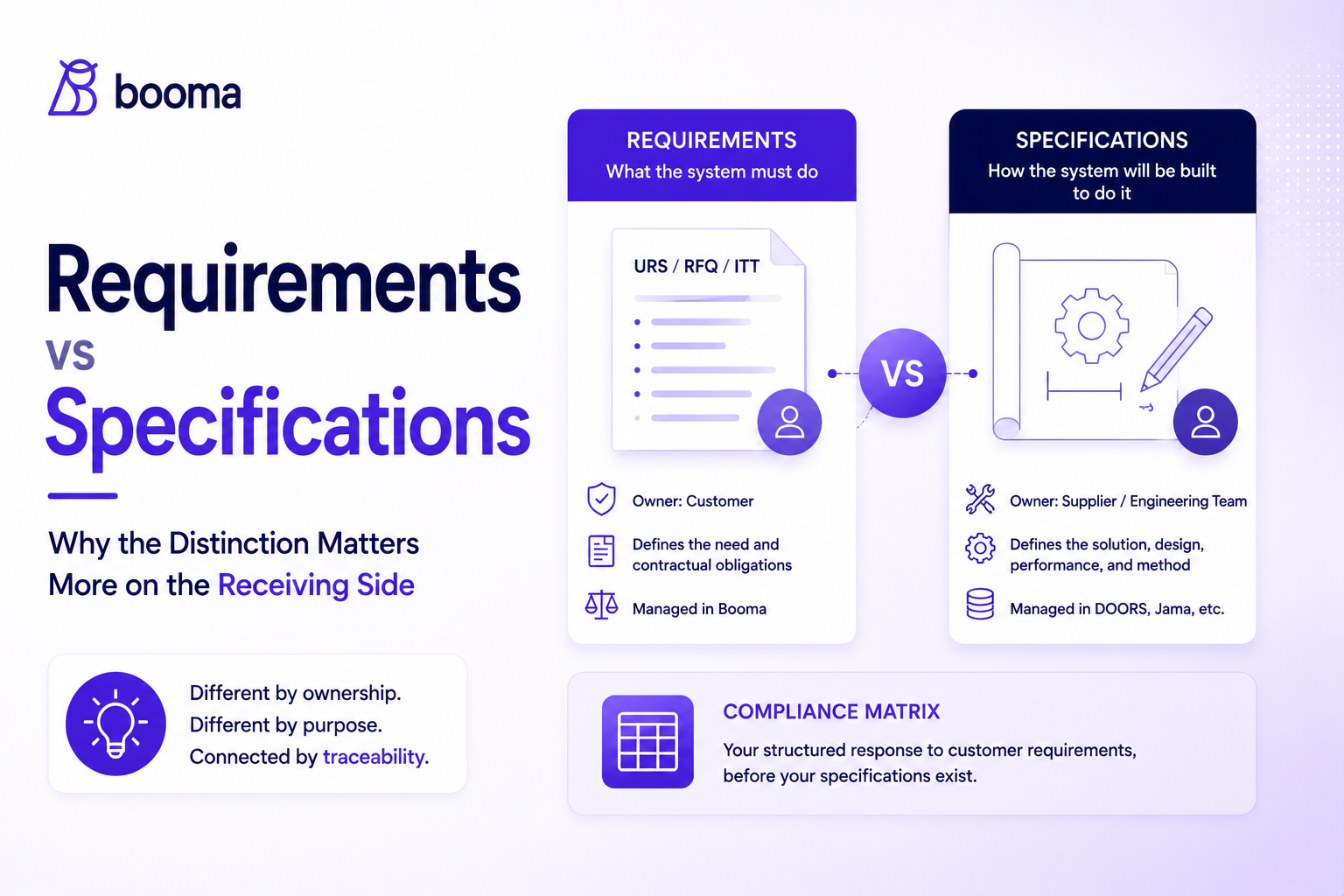
Most engineers who work with customer specifications know the difference between requirements and specifications. Requirements define what a system must do. Specifications define how it will be built. The distinction is clear enough in theory.
Where it gets complicated is the supply chain.
When a customer sends a 400-page URS to a supplier, that document contains requirements from the customer’s perspective. The supplier’s job is to respond to those requirements with a technical proposal and, eventually, a product. The supplier’s internal engineering team then writes specifications defining how the product will be built to meet what the customer asked for.
So the supplier is sitting at the intersection of two worlds: on one side, the customer-issued requirements they must respond to; on the other side, the internal specifications their own engineers must work from.
“The confusion between requirements and specifications on the receiving side is not conceptual. Engineers know the difference. The problem is that most tools and processes treat both as the same thing, so the boundary gets blurred in practice.”
— Anuraj Suman, Principal AI Engineer, Booma
Getting the boundary wrong has real consequences. It determines what tool manages each document, who owns it, what the deliverable to the customer looks like, and where liability sits if something goes wrong.
[KEY TAKEAWAYS]
- Requirements define what a system must do. Specifications define how it will be built to do it. The distinction holds whether you are on the authoring or the receiving side.
- On the receiving side, the customer-issued URS or RFQ or ITT contains requirements. Your internal engineering documents defining how you will meet them are specifications.
- Tools like DOORS and Jama were built to manage the specifications your engineering team authors. Booma was built to manage the requirements your customers send you.
- The compliance matrix sits at the boundary: it is your structured response to customer requirements, before your specifications exist.
- Traceability across the boundary, from customer requirement through your compliance response through your internal specification, is the chain that holds up at FAT.
What Requirements Are
A requirement states what a system must do, achieve, or satisfy, without prescribing how. It is written from the perspective of a need: a performance level, a safety threshold, a regulatory obligation, a user outcome. The test of a well-written requirement is that multiple technically valid solutions could satisfy it.
On the receiving side, requirements arrive in documents your customer controls: a User Requirements Specification, a Request for Quotation, an Invitation to Tender, a technical procurement specification, a supply quality manual. The customer owns these documents. The customer decides when they change and what the new version says. Your job is to respond to them.
You did not write these requirements. You cannot rewrite them. You cannot defer them. You assess whether you can meet them, document your compliance position, and stand behind that position for the duration of the project.
What Specifications Are
A specification defines how a system will be built to meet the requirements it must satisfy. It is written from the perspective of a solution: the engineering decisions, material choices, dimensional tolerances, algorithm implementations, component selections, and interface definitions that translate a requirement into something buildable.
On the receiving side, specifications are documents your organisation controls: your standard product specification, your engineering design documentation, your test specifications, your manufacturing documentation. Your engineers write them, your internal review process approves them, and your change control process manages them.
These are the internal documents that substantiate your compliance claims. When the compliance matrix says Fully Compliant and cites IS-1234 Section 4.2, IS-1234 is a specification. It is your evidence.
Where the Boundary Sits on the Receiving Side
The boundary is easiest to see through document ownership.
The customer-issued URS is a requirements document. The customer controls it. When it changes, the customer decides. Your obligation is to respond to every clause.
Your compliance matrix is your structured response to the customer’s requirements. You control it on your side, the customer receives it, and on contract award it typically becomes a contractual annex. It sits at the requirements level: it addresses the customer’s requirements without yet defining how your engineering will meet them.
Your internal product specification is a specification document. You control it. It defines how your product is built. It is the evidence that substantiates your compliance claims. When the compliance matrix says Fully Compliant, your specification is what it is Fully Compliant with.
The traceability chain that connects them runs from customer requirement through compliance response through internal specification. That chain is the audit evidence at FAT. Both ends need to exist, and the link between them needs to be maintained.
Why the Distinction Matters Commercially
Getting the boundary wrong creates problems that show up at the worst time.
Treating customer requirements as your own specifications. Some teams respond to a customer URS by copying its clauses into their internal engineering documents as if they were their own specifications. The clauses were written by the customer’s engineering team for the customer’s context. They may not map cleanly onto how your product is designed. Conflicts surface during design and nobody knows whether to resolve them by changing the design or pushing back on the customer.
Treating your specifications as the customer’s requirements. Some teams respond to a customer URS by asserting that their standard product specification already covers everything, without actually tracing which customer clauses their specification addresses and which it does not. The compliance matrix looks complete. The gaps show up at FAT.
Losing the boundary in tool management. DOORS and Jama and Polarion are built to manage requirements and specifications authored by your own engineering team. They are excellent at that job. They were not designed to ingest a customer-issued URS, extract its clauses, and manage your compliance response to each one. Teams that try to use authoring-side tools for the receiving-side job end up with a workaround that works until it does not.
“The tool mismatch is where most of the practical confusion comes from. Teams use DOORS to manage their own product requirements and then try to import the customer URS into the same structure. The two things don’t belong in the same database, because one is something you authored and the other is something you’re responding to.”
— Anuraj Suman, Principal AI Engineer, Booma
How the Two Sides Work Together
Requirements and specifications do not compete. They connect. The chain looks like this.
The customer issues a URS. It contains requirements: what your delivered system must do.
You extract every clause, classify it, and draft a compliance response in your compliance matrix. The matrix operates at the requirements level: it addresses the customer’s requirements without yet specifying how your engineering will meet them.
Your engineering team translates your compliance commitments into internal specifications: design documents, test plans, manufacturing instructions. These specifications define how you will actually build a system that meets what you committed to in the matrix.
Traceability links every customer clause through your compliance response to the internal specification that implements it and the test step that verifies it. This is the chain FAT engineers follow.
Each link in this chain involves a tool. Booma manages the receiving side: customer clause to compliance response to compliance matrix. Your engineering tooling (DOORS, Jama, your CAD and PLM environment) manages the specification side: from your compliance commitments through design through test. The two tools need to connect at the handoff point: the accepted compliance commitment that drives your internal specification.
Common Failure Modes
Compliance commitments that do not trace to internal specifications
The compliance matrix says Fully Compliant. The internal engineering team was not aware of the specific commitment made. Nobody translated the compliance position into a specification requirement for the design team. The product gets built to the standard specification. The specific customer requirement that the matrix committed to is never addressed in the design.
Internal specifications that drift from compliance commitments
The compliance matrix is submitted. During project execution, the engineering team makes design changes. Some of those changes affect the capability claims made in the compliance matrix. Nobody updates the matrix. By FAT, the submitted compliance position and the actual product capability have diverged.
Customer URS clauses managed in the wrong tool
A team uses DOORS to manage both their own product requirements and the customer-issued URS clauses. The tool was not designed for the latter. Extraction is manual. The compliance workflow is a workaround. The link between customer clause and internal specification is maintained by convention rather than by the tool, and breaks down under project pressure.
Specifications submitted to customers instead of compliance responses
Some teams respond to a customer URS by sending their internal product specification rather than a structured compliance matrix. The customer has to read through the specification to assess which clauses are covered. Gaps are invisible. This is a documentation practice that puts the burden of compliance assessment on the customer and creates disputes about what was committed.
Benefits of Maintaining the Distinction
[TABLE]
Benefit
- Clear accountability
- Right tool for each job
- Defensible compliance positions
- Controlled change management
- Audit-ready traceability
What it means in practice
- Customer requirements are managed by the bid engineering team. Internal specifications are managed by the engineering team. Neither crosses into the other’s domain without a formal handoff.
- Receiving-side tools manage customer requirements and compliance responses. Authoring-side tools manage internal specifications. Each does its job without workaround.
- Compliance claims trace to internal specifications that substantiate them. At FAT, the chain from customer clause to evidence is intact.
- When the customer changes a requirement, the receiving-side process handles the revision. When internal design changes affect a compliance commitment, the specification update triggers a review of the corresponding compliance response.
- The chain from customer clause through compliance response through internal specification through FAT test step is the compliance audit trail that regulated procurement requires.
Real-World Example
CIMC Pteris, Asia’s largest airport logistics integrator, works with customer specifications that are among the most complex in their industry. Their incoming URS documents regularly reference more than seven EN ISO standards simultaneously across several hundred pages.
Their engineering teams author internal specifications for the systems they design and install. These are their own engineering documents, managed through their own design review and change control processes.
Managing the gap between what a customer asks for in a URS and what their internal engineering documents specify is the core challenge. A customer clause that commits to EN ISO 12100 compliance has to trace from the URS through the compliance matrix through the specific design documentation that implements it and the test record that verifies it.
Before Booma, this chain was maintained manually and broke down most visibly at the revision step: when a customer issued a new URS version, identifying which compliance commitments and which internal specifications were affected required manual cross-referencing across multiple document types.
After implementing Booma, the receiving side of this chain is managed automatically. Customer clauses are extracted, classified, and linked to compliance responses in a structured environment. The handoff point to internal engineering is clean: an accepted compliance commitment with the specific internal evidence cited.
Gustav Ryan, Operations Director at CIMC Pteris: “When a customer issues a change request mid-project, we used to spend days tracing it across documents. With Booma, we can respond with a defensible, audit-ready answer the same day.”
What AI Changed
Maintaining the boundary manually at scale meant linking customer clauses to internal evidence by hand, which got slower and less reliable as bid volume grew. Two specific capabilities changed that.
Semantic classification at extraction. AI can now read a customer clause and assess whether it is more likely to be a functional requirement, a performance requirement, a regulatory requirement, or a specification-level prescription masquerading as a requirement. Clauses where the customer has effectively written a specification (specifying a particular component, technology, or implementation approach) get flagged for review rather than accepted at face value as response-level requirements.
Cross-document similarity. AI can surface the internal specification most likely to cover a new customer clause, based on semantic similarity with prior compliance responses and the evidence documents cited. The link from customer requirement to internal specification that used to require expert knowledge to establish now has a suggested starting point.
[TABLE]
Traditional
- Requirements vs specification classification by human review
- Internal evidence located by expert memory
- Requirement-to-specification links maintained manually
- Boundary maintained by convention
AI-Powered
- AI classification flags specification-level clauses in customer documents
- Similarity-scored evidence suggestions from prior bid history
- AI-suggested links from customer clause to internal evidence
- Boundary enforced by tool structure
How Booma Helps
Booma manages the receiving side of the requirements-specification boundary: from the moment a customer document arrives through extraction, classification, compliance response, and compliance matrix submission.
Every customer clause in Booma is a received requirement. The tool is structured around the receiving-side job: extracting clauses, managing compliance responses, maintaining revision history, and surfacing prior evidence.
The handoff from Booma to your authoring-side tooling happens at the accepted compliance commitment. A compliance position accepted by your engineering review team carries with it the evidence reference, the internal specification cited, and the compliance history. That is the starting point for your internal engineering process, not a clause from a customer document that has to be re-interpreted.
DOORS and Jama manage what your engineering organisation authors. Booma manages what your customers send you. Together, they cover both sides of the boundary.
Booma is hosted in Germany, ISO 27001 certified, GDPR-compliant, and does not use customer data to train AI models.
[FAQ]
What is the difference between requirements and specifications?
Requirements define what a system must do, from the perspective of a need. Specifications define how a system will be built to meet those requirements, from the perspective of an engineering solution. On the receiving side, requirements come from your customers. Specifications come from your own engineering team.
Why does this distinction matter on the receiving side specifically?
Because on the receiving side, you are managing documents you did not author and cannot change (customer requirements) alongside documents your own team authors (internal specifications). Mixing them in the same tool, the same process, or the same team creates accountability gaps and traceability failures that surface at FAT.
How does the compliance matrix relate to requirements and specifications?
The compliance matrix is your structured response to customer requirements. It operates at the requirements level: it addresses each customer clause without yet defining how your engineering will meet it. Your internal specifications are the evidence that substantiates the compliance claims in the matrix.
What tools manage each side of the boundary?
Authoring-side tools like DOORS, Jama, Polarion, and Visure manage the requirements and specifications your engineering organisation authors. Booma manages the requirements your customers send you. They are not competing tools. They address different sides of the same supply chain.
What happens when a customer specification clause is really a design prescription?
Some customers write clauses that specify a particular technology, component, or implementation approach rather than a performance requirement. These are specification-level prescriptions embedded in a requirements document. On the receiving side, you still have to respond to them, but they need to be flagged: they constrain your solution space and may conflict with your standard product design.
[NEXT STEPS]
Want to understand how the compliance matrix gets built and documented properly?
The Requirements Documentation guide covers what each row needs to contain, how the RTM relates to the matrix, and what makes a compliance position defensible eighteen months after submission.
Need to understand how traceability connects customer requirements to your internal specifications at FAT?
The Requirements Traceability guide covers the full chain from customer clause through compliance response and internal evidence to acceptance testing, and what it takes to keep that chain intact.
Want to see how Booma manages the receiving side of the boundary?
Explore requirements management software for customer-issued documents → or book a demo to see how CIMC Pteris and other teams keep customer requirements and internal specifications separate, with a clean handoff between them.

.png)