.svg)
Requirements Documentation on the Receiving Side: The Compliance Matrix and the Evidence Behind It
.png)
Introduction
Most guides to requirements documentation focus on how to write requirements. How to make them atomic, testable, and unambiguous. How to structure a system requirements specification. How to manage a stakeholder needs document through review and baseline.
All of that is real and worth doing. It is just not what bid engineers are documenting.
On the receiving side, the documentation problem is not how to write requirements. It is how to document responses to requirements someone else wrote, in a format that survives bid submission, contract award, project execution, factory acceptance, and whatever dispute comes after. The primary deliverable is not an SRS. It is a compliance matrix backed by versioned evidence.
“The compliance matrix submitted at bid is a legal document. Most teams treat it like a spreadsheet they built under time pressure. Those are not the same thing, and the difference shows up at FAT.”
— Stephan Seider, CPO, Booma
This article covers what receiving-side documentation actually requires, what a compliance matrix contains and what it does not, how evidence documentation works, and why most teams discover the gaps in their documentation at the worst possible moment.
[KEY TAKEAWAYS]
- On the receiving side, the primary documentation deliverable is the compliance matrix: a structured response to every customer clause, with compliance status, justification, and evidence references.
- The compliance matrix submitted at bid typically becomes a contractual annex. Every row is a binding commitment.
- Evidence documentation is what makes compliance commitments defensible at FAT. Without versioned, retrievable evidence, a compliance claim is an opinion.
- The compliance matrix and the internal requirements traceability matrix are not the same document. The RTM produces the matrix and retains everything the customer does not see.
- AI automates extraction and structure at intake, so the documentation starts with a complete, classified, traceable record on day one rather than being assembled retroactively.
What Documentation Means on the Receiving Side
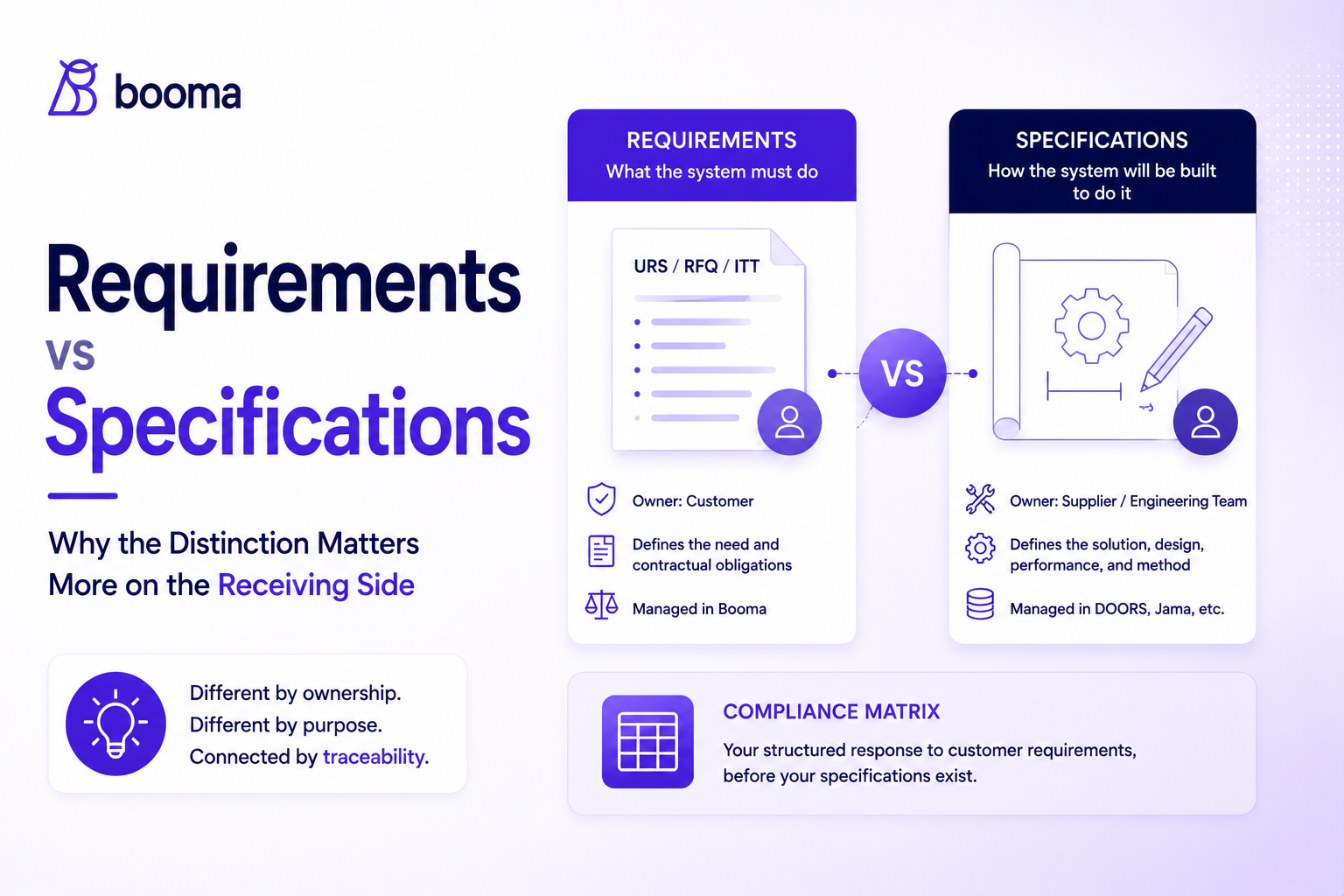
On the authoring side, requirements documentation means capturing what a system must do in a structured, traceable format, from stakeholder interviews through a baselined specification. The deliverable is an internal artefact managed through design and verification.
On the receiving side, documentation means something else. The requirements already exist. A customer wrote them and sent them to you. Your documentation job is to record your response to every one of them in a format that is structured, justified, evidenced, and auditable across an eighteen to thirty-six month project lifecycle.
Two documents carry this work, and they are related but distinct enough that confusing them causes real problems.
The compliance matrix is the customer-facing deliverable. It goes to the customer at bid submission and typically becomes a contractual annex. Each row shows a customer clause and the supplier’s compliance status with a short justification and an evidence reference. The format is usually specified by the customer.
The internal RTM is the supplier’s working document. It produces the compliance matrix and adds everything the customer does not see: source page and paragraph, atomic clause splits, classification metadata, internal team assignments, full justification text, versioned evidence references, option lines with commercial deltas, contract reference, FAT test step links, and revision history. A typical RTM row has twenty or more columns. The compliance matrix is a five to eight column export from it.
Maintaining them as separate documents is the most common cause of divergence between what was submitted and what the internal record shows. The compliance matrix should be a view exported from the RTM, not a parallel spreadsheet someone assembled the day before submission.
What the Compliance Matrix Actually Contains
A properly structured compliance matrix is not a two-column table of clauses and yes/no answers. Here is what each row needs to carry.
Customer clause reference. The customer’s own numbering and section heading. If the customer disputes a row, both parties need to be looking at the same clause in the same document.
Customer clause text. The verbatim text of the clause, not a paraphrase. Paraphrases introduce interpretation at submission that creates disputes at FAT.
Compliance status. One of five options: Fully Compliant, Partially Compliant, Non-Compliant, Comply with Comment, or Not Relevant. Each has a specific meaning and implications for what justification is required.
Justification. A clear statement of why the compliance status claimed is accurate. For Fully Compliant, this references the evidence. For Partially Compliant, it names the option and the delta. For Non-Compliant, it states the principled basis for rejection. For Comply with Comment, it names the deviation or clarification.
Evidence reference. The specific internal document, section, and version that substantiates the compliance claim. This is the most important field for audit defence. A compliance claim without an evidence reference is an assertion, not a documented position.
Option line. For Partially Compliant responses, the named option, its price delta, and its lead-time impact. This is a commercial commitment as well as a technical one.
Responsible internal team. Who owns this row. Two years later, when the question is who decided this and whether they had the authority to commit, the matrix has an answer.
What goes in the RTM but not in the customer-facing matrix: source page and paragraph, atomic split detail, classification tags, full internal justification, contract reference, FAT test step link, and the full revision history showing how the response evolved across document versions.
Why Documentation Fails on the Receiving Side
“The documentation we see most often at bid is accurate as of submission day. The problem is that it was never designed to survive the project. By FAT, the evidence references point to documents that no longer exist in the same form, and the people who made the compliance decisions are not always still there.”
— Stephan Seider, CPO, Booma
Evidence references that do not survive the project
A compliance response cited Internal Specification IS-1234 Section 4.2. Eighteen months later, IS-1234 is at Revision 3. Section 4.2 has been restructured. The evidence reference in the compliance matrix now points to a document version that no longer exists in that form.
Without versioned evidence references tied to document snapshots, the link between compliance commitment and evidence degrades silently. Nobody knows until FAT, when it matters most.
Compliance matrix and RTM maintained separately
The compliance matrix gets submitted. The RTM continues to evolve during project execution. By FAT, the two documents no longer say the same thing. When a customer asks about a specific row in the submitted matrix, the supplier cannot find the corresponding internal record without forensic effort.
Verbatim clause text replaced with paraphrases
A bid engineer paraphrases a 60-word clause as a 12-word summary to save space. The paraphrase loses a nuance. The customer’s interpretation of the original clause and the supplier’s compliance position diverge by FAT. The dispute is about what the clause meant, not about whether the supplier met it.
Justification that does not survive scrutiny
A compliance response says “Fully Compliant per standard product specification.” The FAT engineer asks which section of which specification, at which revision, covers the specific performance parameter in the clause. The answer is not in the matrix. The person who knew the answer left the company.
No revision history on compliance responses
The customer issues URS Rev 4. Three clause responses change. Two years later, both parties are looking at the submitted matrix. The customer is working from Rev 4. The supplier’s matrix row references a clause text that was in Rev 3. There is no record of how the response evolved across revisions.
Documentation assembled at submission rather than maintained throughout
The compliance matrix gets built in the final week of the bid window, assembled from the responses produced by eight different teams in eight different spreadsheets. Inconsistencies in terminology, evidence references, and justification style reflect the assembly rush. The RTM, if it exists at all, is produced after submission rather than being the document from which the matrix was exported.
How Receiving-Side Documentation Should Work
The compliance matrix is not the output of a documentation activity that happens at the end of the bid window. It is a view generated from a structured internal record that has been maintained since the day the customer document arrived.
Getting there requires the following in place from intake.
Verbatim clause capture. Every extracted clause is stored verbatim, with its source page and paragraph. Nothing is paraphrased at the documentation layer.
Atomic splits recorded. Where compound clauses were split into atomic requirements, both the original compound text and the split atomic requirements are in the record. The audit trail shows which atomic requirement came from which part of which compound statement.
Classification stored as structured data. Type, criticality, referenced standard, and internal team assignment are structured fields, not free-text notes. They drive reporting, routing, and export formatting.
Evidence references versioned. Every compliance response cites a specific internal document, section, and version. When the underlying document changes, affected responses are flagged rather than left to decay.
Compliance responses linked to the clause, not just stored. The response, justification, evidence reference, and option line are linked to the specific atomic clause they address. The matrix row is not a parallel entry. It is a derived view of the linked record.
Revision history maintained automatically. Every change to a compliance response, including the triggering event (customer revision, internal evidence update, commercial decision), is logged with timestamp and authorship.
The compliance matrix exported, not manually assembled. At submission, the matrix is generated from the RTM in the format the customer requires. The export is reproducible. The same export run a year later produces the same output against the same data snapshot.
Benefits of Getting Documentation Right
[TABLE]
Benefit
- Defensible compliance positions at FAT
- Single source of truth for matrix and RTM
- Revision history that answers questions
- Consistent documentation quality across teams
- Faster subsequent bids
- Audit-ready from day one
What it means in practice
- Every compliance claim links to the evidence version that substantiated it at the time of submission. The chain does not depend on memory or on people who are still at the company.
- The compliance matrix is an export from the RTM. They cannot diverge because they are the same data rendered differently.
- When a customer asks why a response changed between Rev 3 and Rev 4, the history is in the record. Not in someone’s inbox.
- When eight internal teams contribute responses, a shared RTM enforces structure. Justifications, evidence references, and compliance status language are consistent because they follow the same schema.
- A well-documented compliance history is the knowledge base for the next bid in the same customer family. Evidence references that held up at FAT are the starting point for the next response to similar clauses.
- Documentation built to survive FAT from intake does not need to be assembled retroactively under audit pressure.
Real-World Example
Lödige Industries designs and installs air cargo terminal systems for airports worldwide. Their customer specifications run to hundreds of pages, cover multiple engineering disciplines, and arrive from customers who will hold them to contractual compliance commitments eighteen months to several years later.
Before Booma, their documentation process had a structural problem. Requirements were extracted manually by one person before the rest of the team could start. The compliance matrix was assembled from the outputs of multiple team members working in separate files. There was no systematic link between the submitted matrix and the internal evidence, and there was no version control to show how compliance responses had evolved if a customer asked.
After implementing Booma, Lödige restructured the process from intake. Requirements are extracted and classified automatically. Every clause carries its source page and paragraph from the moment it enters the system. The compliance matrix is exported from the RTM rather than assembled separately. When a customer issues a revision, the changed clauses are flagged and the affected responses are updated with their history preserved.
Jakob Müller, Project Manager at Lödige Industries: “What convinced us most was the immediate and noticeable relief in handling complex and numerous customer requirements through automated extraction.”
The documentation quality did not improve because the engineers became more diligent. It improved because the process stopped relying on diligence to compensate for a tool that was not designed for the job.
What AI Changed
The documentation steps that used to create the most problems — verbatim capture, evidence linking, and revision tracking — are now automatable.
Extraction and verbatim capture. Source page, paragraph, and verbatim clause text are captured automatically at intake. The foundation of the compliance record is established before any engineer opens the document.
Structure enforcement at entry. Classification tags, evidence reference fields, and compliance status options are enforced at the point of entry rather than standardised retroactively. Responses that do not have an evidence reference cannot be marked Fully Compliant.
Evidence link monitoring. When an internal evidence document is updated, Booma flags every compliance response that cites a previous version. The decay that used to happen silently across eighteen months is surfaced in real time.
[TABLE]
Traditional
- Verbatim clause text captured manually or paraphrased
- Evidence references added informally
- Compliance matrix assembled from multiple files
- Evidence decay discovered at FAT
AI-Powered
- Verbatim capture with source page and paragraph at extraction
- Structured evidence reference fields enforced at entry
- Matrix exported from single RTM source
- Affected responses flagged when evidence documents change
How Booma Helps
When a customer document comes into Booma, the documentation record starts immediately. Every extracted clause carries its source document, version, page, and paragraph. Classification is structured data. Evidence reference fields are enforced before a compliance response can be marked Fully Compliant.
The compliance matrix is not a separate document that someone maintains in parallel. It is a filtered, formatted export from the RTM, generated in the format the customer requires. Running the same export against the same data snapshot twelve months later produces the same output. The compliance position at bid submission is reproducible.
When internal evidence documents are updated, Booma surfaces the compliance responses that cited previous versions. The team can review and update affected responses or confirm that the previous evidence version still applies. Either way, the decision is recorded.
When the customer issues a document revision, changed clauses flow through the same documentation structure. New clause text is captured verbatim, prior responses are flagged for review, and the revision history is maintained automatically.
Booma is hosted in Germany, ISO 27001 certified, GDPR-compliant, and does not use customer data to train AI models.
[FAQ]
What is the compliance matrix?
It means sorting incoming customer clauses by risk and routing them to the right people before the bid window runs out. The four categories are: non-negotiable regulatory and safety requirements, commercial escalation candidates, technically complex clauses needing senior review, and standard-product clauses that can be handled efficiently.
What is the difference between a compliance matrix and a requirements traceability matrix?
The compliance matrix is the customer-facing deliverable: five to eight columns exported at submission. The RTM is the supplier’s internal working document: the full record that produces the matrix, including source page and paragraph, classification metadata, internal team assignments, versioned evidence references, revision history, and FAT test step links. The matrix is a view of the RTM. They should not be maintained separately.
Why do evidence references matter so much?
A compliance claim without an evidence reference is an assertion. At FAT, assertions get challenged. Evidence references that point to specific internal documents, sections, and versions allow the supplier to reconstruct the basis for every compliance commitment, regardless of how much time has passed or how much the team has changed.
What happens to documentation when the customer issues a revision?
In a structured process, changed clauses are identified automatically and affected compliance responses are flagged for review. The revision history shows what the previous response was, what triggered the change, and who updated it. In a spreadsheet-based process, this is a manual exercise that typically adds days to an already tight bid window.
How does AI improve receiving-side documentation?
It automates verbatim clause capture with source page and paragraph at extraction, enforces structured evidence reference fields before responses can be marked compliant, monitors evidence documents for changes and flags affected responses, and generates the compliance matrix as a reproducible export from the RTM rather than a manually assembled file.
[NEXT STEPS]
Want to understand how documentation fits into the full receiving-side workflow?
The Requirements Management Process guide covers the nine-step workflow, including where documentation structure is established at intake and how it feeds through to compliance matrix submission.
Need to understand how traceability connects the compliance matrix to FAT and SAT?
The Requirements Traceability guide covers the full chain from source clause through compliance response through contract commitment through acceptance testing, and what it takes to keep that chain intact across eighteen to thirty-six months.
Want to see how Booma structures compliance documentation from intake through FAT?Explore the product → or book a demo to see how Lödige Industries and other teams build compliance documentation that holds up under scrutiny.